
Travel diaries are a well-established genre. We’re all familiar with those classic leather-bound books, filled with flight itineraries, hotel names and bullet-point lists of sights – pure aesthetics. I suggest narrowing the focus.
Instead of keeping a conventional travel journal, incorporate a special ‘Art Journal’ into your daily travel routine.
An art travel journal will help you delve deeper into art, analyse cultural landscapes more closely and develop your creative imagination. As a result, you’ll build up a valuable physical archive of your travels. You’ll no longer need to use your notebook simply as a passive repository for tickets – it will become an active element that defines your travel style. Here’s how to develop this habit.
Table of Contents
What exactly is an Art Travel Diary?
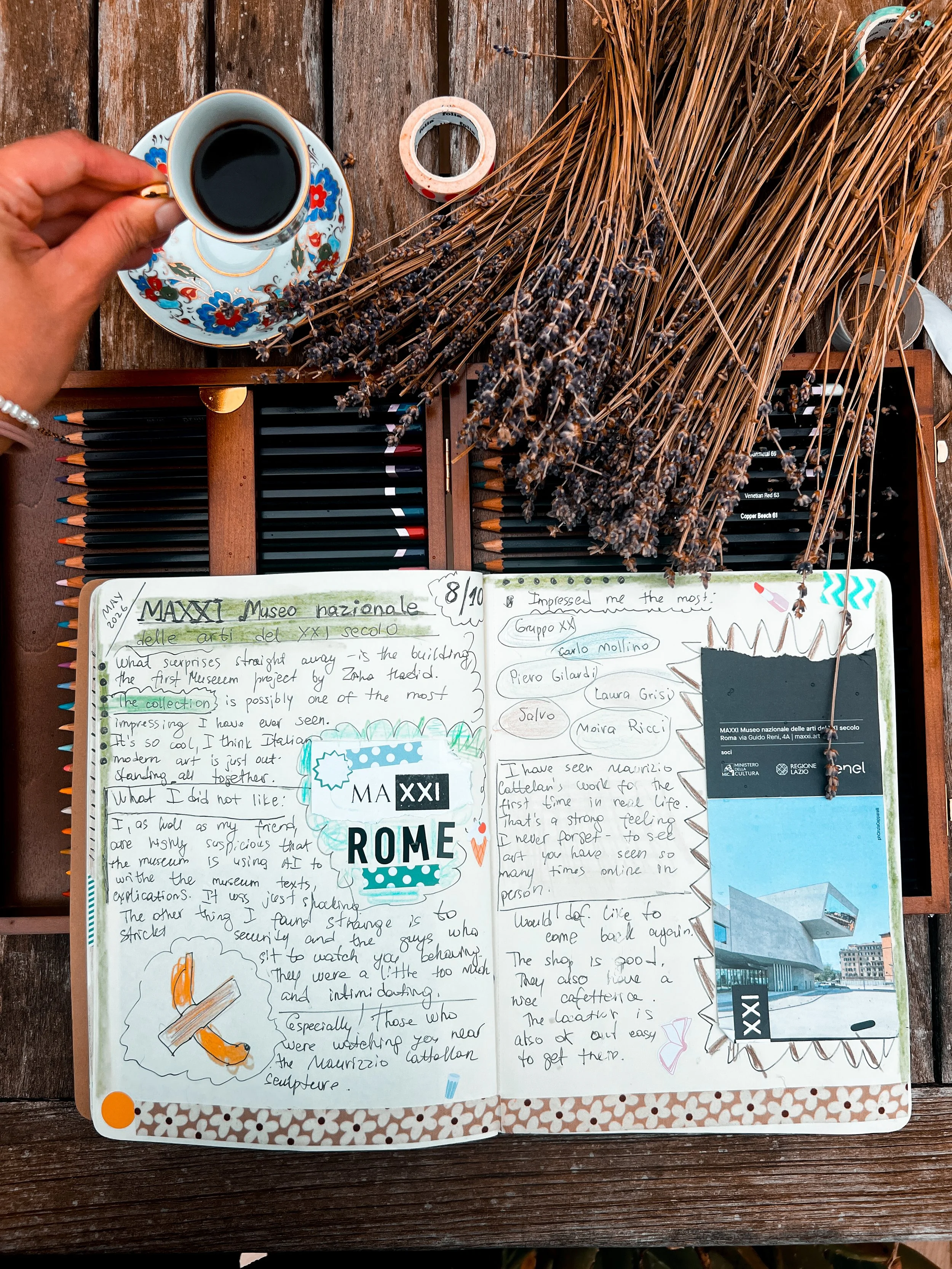
‘The Art Travel Diary’ is your personal, handwritten archive of all the cultural experiences you encounter whilst travelling. You can keep it wherever you encounter expressions of human creativity — in museum galleries, contemporary art galleries, at independent art fairs, on historic street corners or in ancient architectural monuments.
Its main purpose is to create a space for unhurried reflection: a personal space where you consciously re-examine everything your eyes have taken in.
Your observations, jotted down by hand on paper, transform you from a passive observer into an active cultural analyst. This notebook will serve as a direct platform for your personal immersion in the history of art.
This includes:
museums and galleries
exhibitions and art fairs
street art and architecture
cultural spaces and even small details
Why you need to welcome Mindfulness into your journeys
The unsettling reality of modern travel is that we rarely remember our experiences the way we think we do. We walk through world-class galleries snapping hundreds of rapid, mechanical photos on our smartphones. At worst, those digital files sit forgotten in a cloud storage loop; at best, they are compressed into a fleeting social media post.
An Art Diary completely rewrites this dynamic. It changes both your pacing and your sense of place. Instead of viewing a museum as an item to cross off an itinerary, your notes turn that space into a personal intellectual landscape.
You are probably not remembering your travels the way you think you are. My entire blog is dedicated to showing how to view the world through art and culture in a way that allows us to learn, remember and turn every trip into an unforgettable, enriching experience.
We snap hundreds of photos on our smartphones, which, at worst, we’ll never look at again, and at best, we’ll post a couple on Facebook or Instagram.
If you have kids and travel with them — great. Try doing it together. It is a great family bonding moment, and your kids will love it doing it with you.
How exactly an Art Travel Diary changes your travel experience
— Slows you down
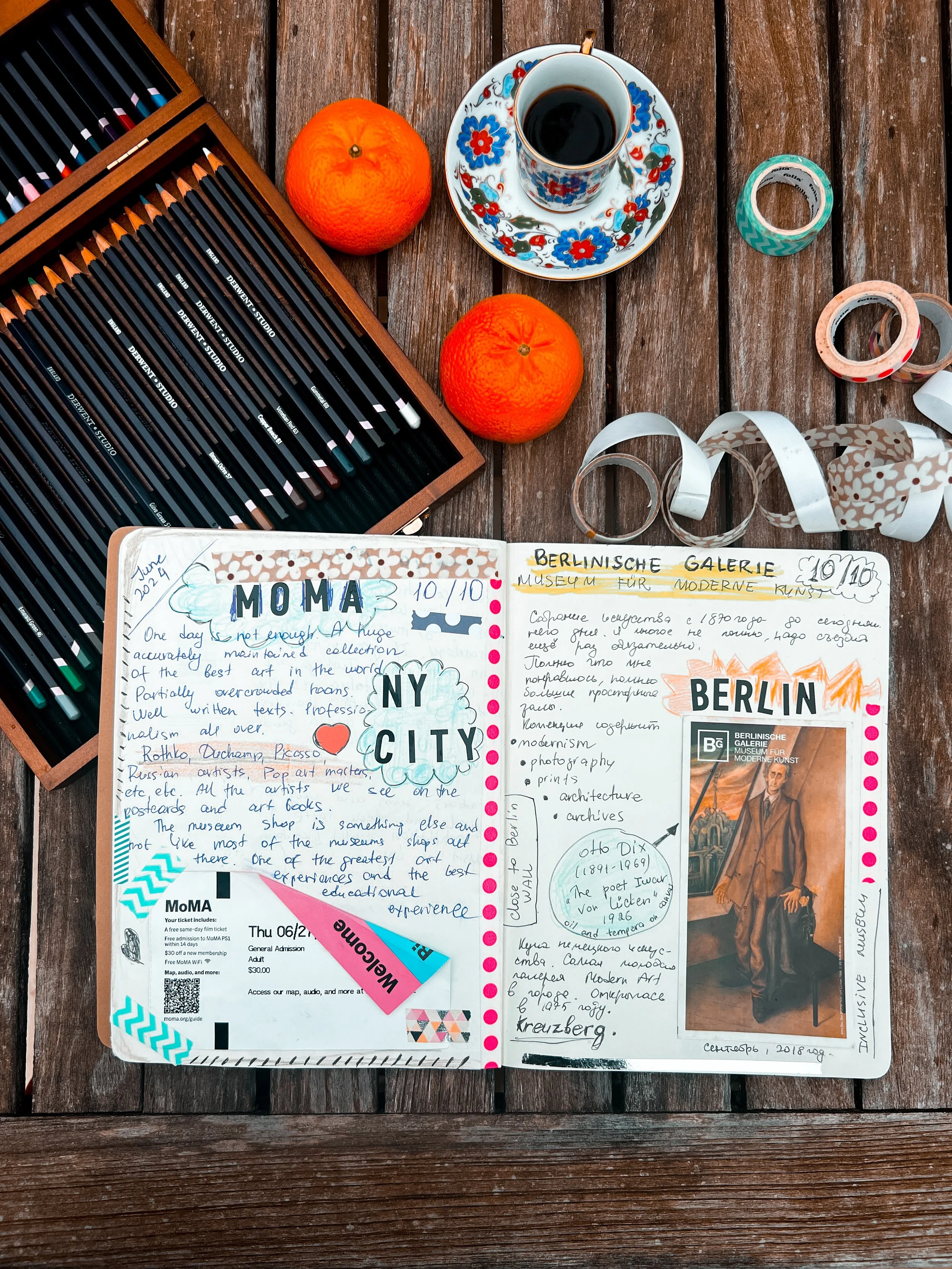
You stop mechanically browsing and looking around museums, galleries, architectural monuments and so on; instead, you suddenly stop rushing and start observing at a leisurely pace.
As your diary is a space for reflection, it will teach you to analyse what is happening more deeply. Crucially, writing by hand improves your mental health and brain function.
— Trains your eye
With manually fixing what you see and feel, you begin to notice things that normally fade away in a carousel of rapid scenes. You see different patterns, small details, repetition, visual language of the place.
— Makes the experience personal
You transform every place not just into ‘yet another museum’, but into something you have reflected on and interpreted in your own way. You’ll remember your trip more vividly and retain the details that define the whole experience.
Narrow your focus — curation over collection
So, it’s up to you to decide what you want to take away with you.
This could be just single work of art. Or a single room. A single detail. The overall atmosphere.
Did you enjoy the coffee in the museum café? Great, make a note of it.
Was there a sculpture that struck you? Describe it.
Did the museum’s architecture surprise you? Tell about it.
Your diary doesn’t have to be linear. Mix notes, textures and little observations.
Let it remain unfinished. When you leaf through your art diary (and you will), you’ll want to return to certain pages.
Make a list of the works or artists that intrigued you most, and when you get home, read about them online.
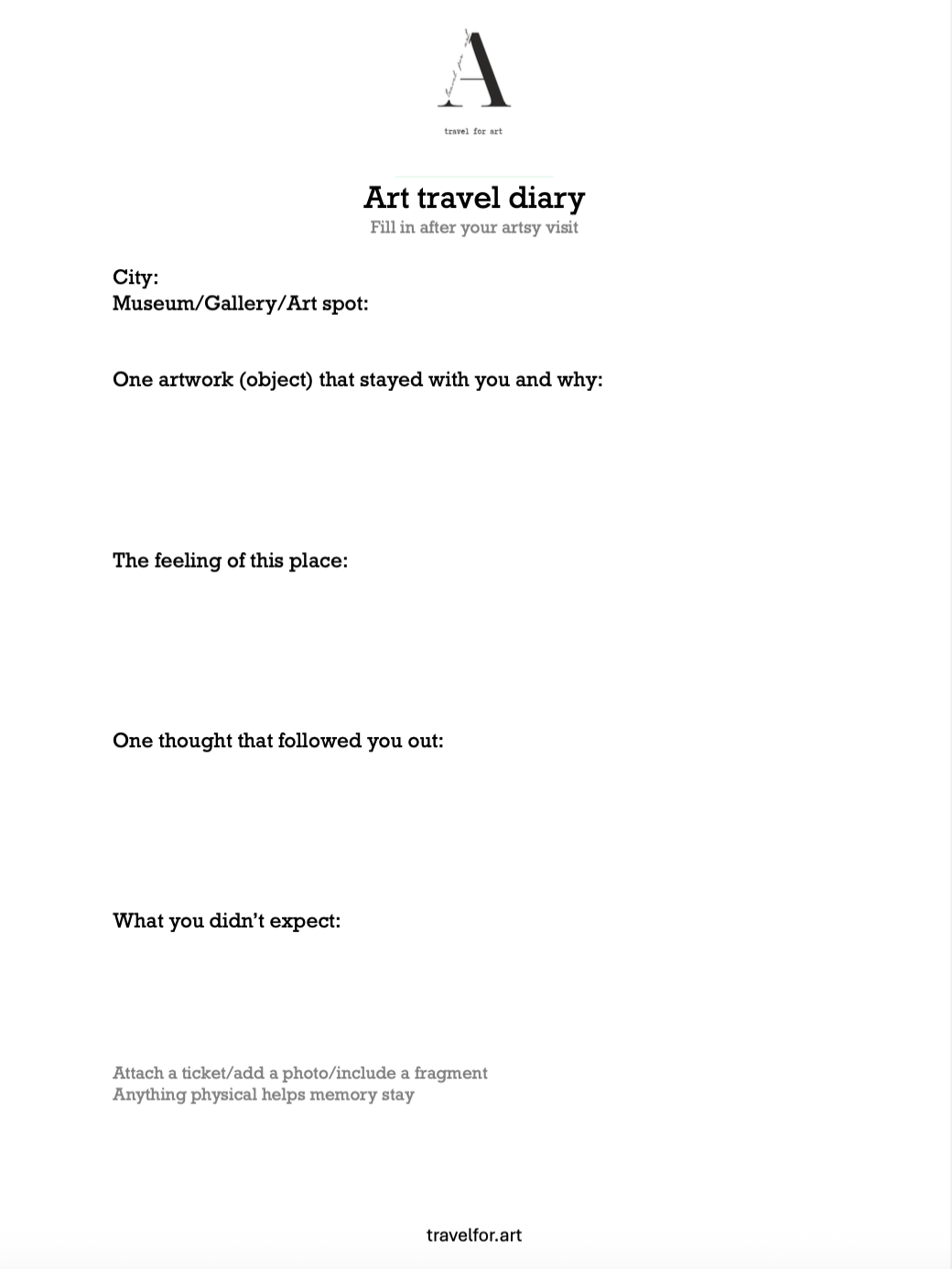
Use my simple template (just as an example) as a starting point for your Art Diary and feel free to alter it as it goes.
You’re not making a beautiful notebook
It’s very important to understand this. Your art diary isn’t for flexing on Pinterest. It is not bout perfect sketches or aesthetically pleasing pages. Which is a good news, becaus it spares you of the stress and pressure.
You art journal is about leaving a record of your thought process. Our aim is to think, reflect, write by hand and enjoy the whole process. All the visuals play only a supporting role.
✨ The Art-Flâneur Prompts: What to Write When You’re Stuck
The hardest part of art journaling is facing a blank page. The next time you sit in front of a masterpiece and find yourself without words, choose one of these thematic prompts to kickstart your creative stream of consciousness:
Deconstructing the Technique
- Where is the primary light source coming from, and how does it alter the mood?
- If you could touch the canvas, what would the texture feel like? (Heavy impasto, smooth enamel, raw linen?)
- What are the three dominant colors, and what emotional resonance do they trigger?
The Spatial Narrative
- How does the museum architecture or lighting affect the way you see this specific work?
- Look at the people surrounding the artwork. How are they reacting? Is there a shared silence or a soft buzz?
- If you could step inside this painting, what would you hear, smell, or feel immediately?
Personal Dissection
- Does this work remind you of a specific book, piece of music, or a memory from your own past?
- What questions would you ask the artist if they were sitting next to you on the gallery bench right now?
- Why did your eyes stop precisely on this piece instead of the dozens of others in the room?
There are no rules
You can write badly, even draw nothing, skip pages, come back later. This is your space with your own rules.
No, you don’t need to record everything, just the essentials. You decide what’s essential. Not your art guide, not the audio guide, not the travel guide – just you.
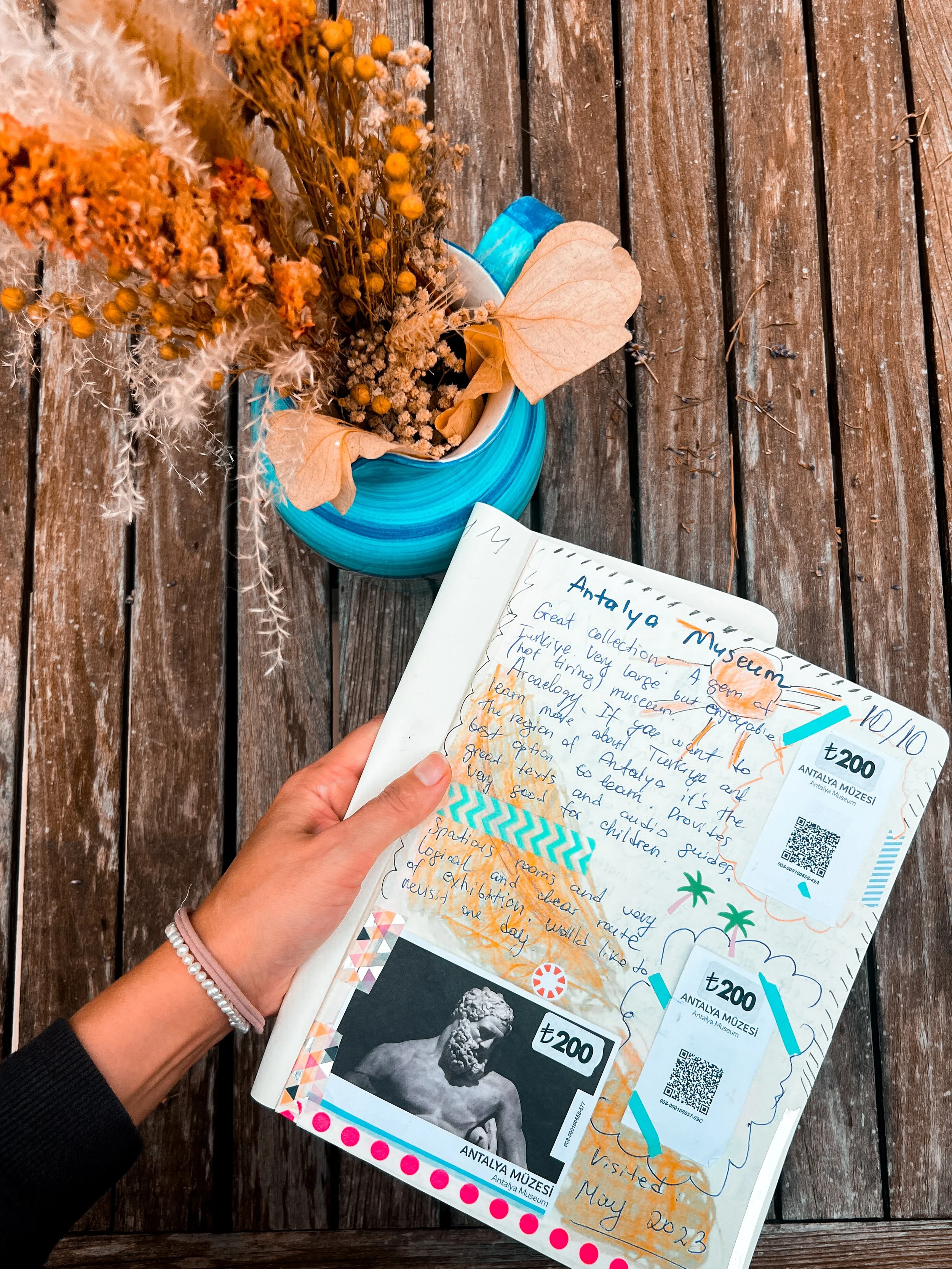
The material archive — collect physical ephemera
I understand digital tickets are more convenient, but try to seek out physical ephemera. Secure your paper entrance tickets, exhibition maps, café receipts, or local gallery cards and paste them directly onto your pages.
Many world-class institutions treat their physical tickets as miniature works of art in their own right, printing iconic close-up details from their collections or architectural line drawings of their facades on the cardstock.
These physical textures add a beautiful, tactile dimension to your book, turning it into a tangible time capsule of your travels.
How to launch your art diary today
Do not buy an intimidating, hyper-expensive journal. Pick a simple, lightweight notebook that frees you from the pressure of making mistakes.
Open the first page tonight. Sit down and write a detailed, sensory paragraph about the last museum or historic space you visited entirely from memory. This is your baseline entry.
On your next cultural excursion, pick one single painting or sculpture. Put your phone away, sit on a gallery bench, and look at it for 10 uninterrupted minutes before you write a single word.
Use the final pages of your entries to jot down names of intriguing artists you discovered by accident. When you return to your hotel or home, use those names as a springboard for further late-night reading.
