
Where to see Russia’s oldest icons and frescos: Veliky Novgorod Kremlin
Veliky Novgorod — the cradle of Russian democracy (where early democratic processes took root in the 12th century) and one of the oldest Russian cities (founded in 859 AD). It is also the birthplace of a distinct, visually striking school of sacred painting, icons and church frescos. When you travel, let’s say in Italy, you enjoy beautiful church murals. Well, I am going to tell you that Russian church frescos and icons are also worth, worth seeing. Novgorod is the right place for that.
Alas the devastation of World War II and the Soviet era scattered many early masterpieces globally. However, many icons and frescos were saved and now Velikiy Novgorod is the true heart of pre-Mongol icon painting.
Before you step inside Velikiy Novgorod’s Kremlin, let us see some of the masterpieces that define the world of early Russian iconography and fresco painting.
Table of Contents
The State Museum-Preserve, main building (Kremlin, 11)
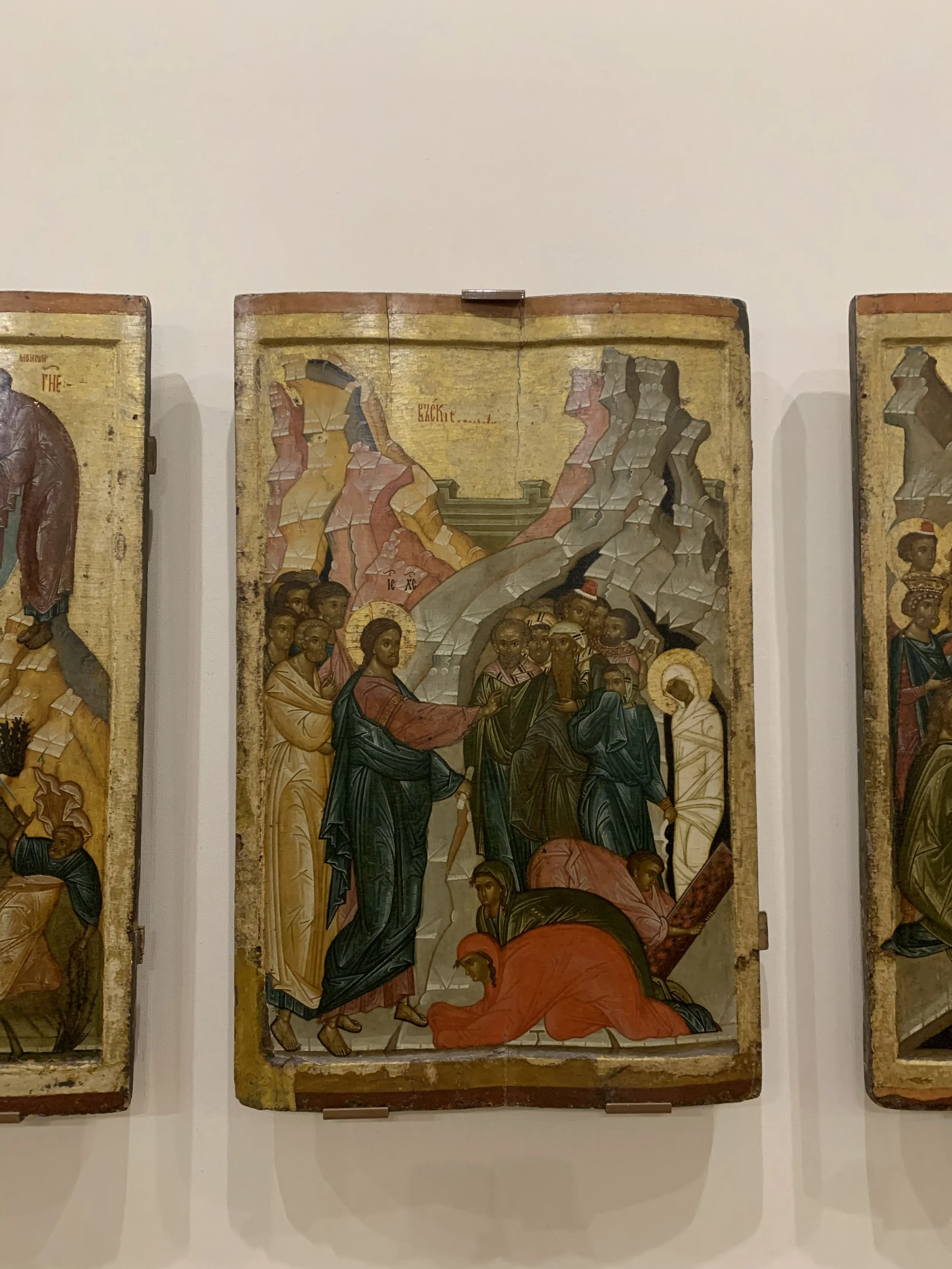
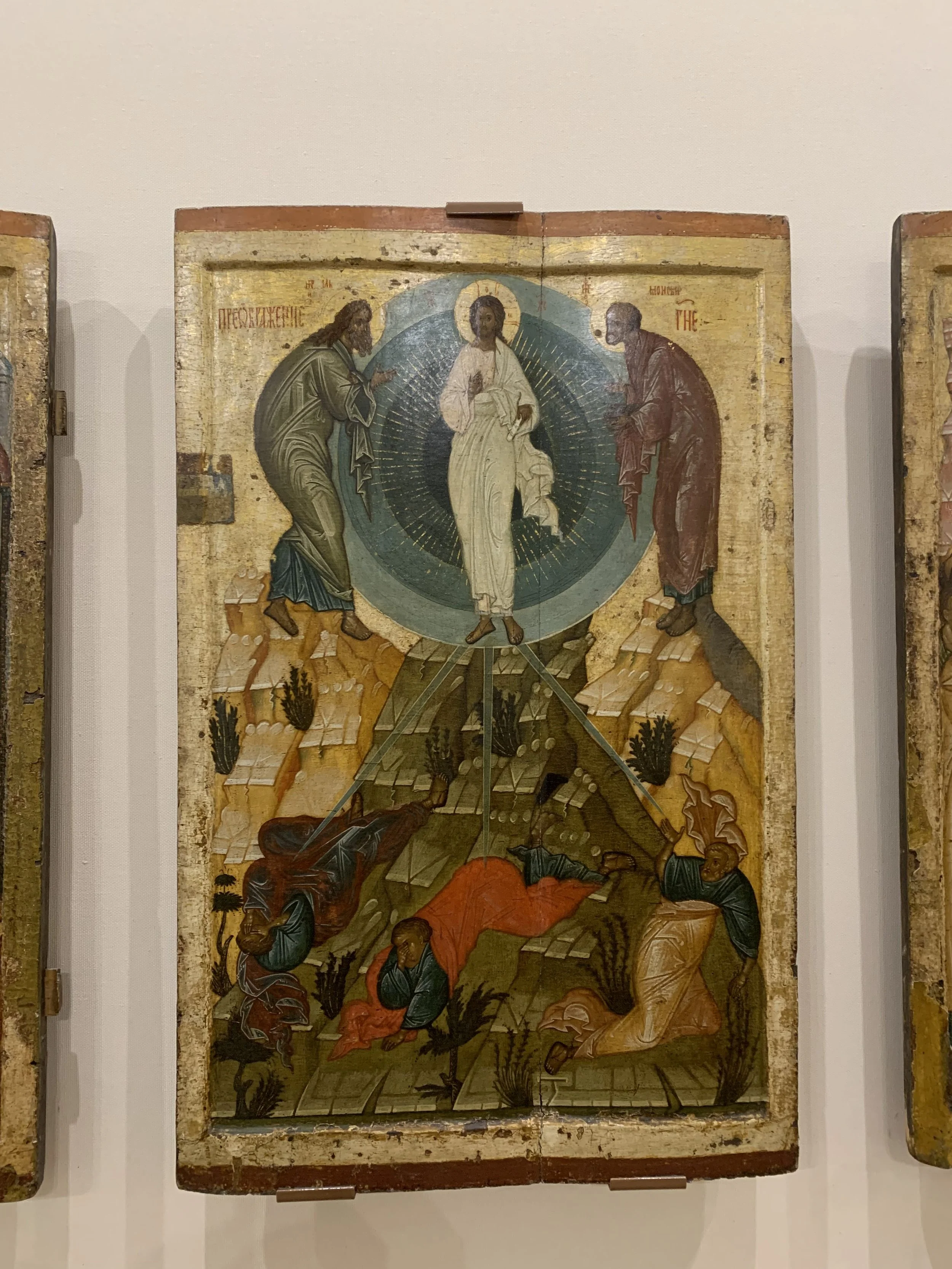
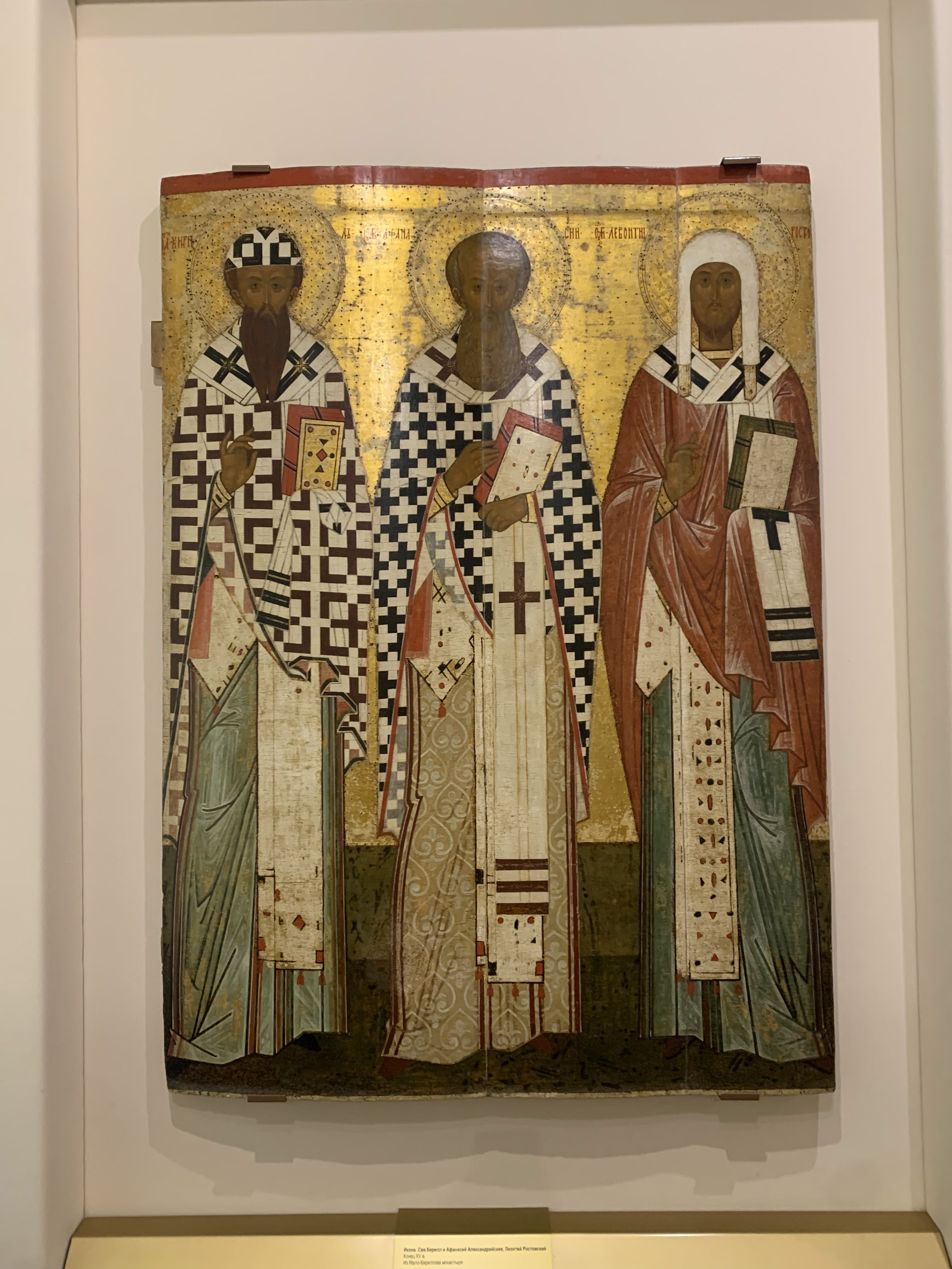
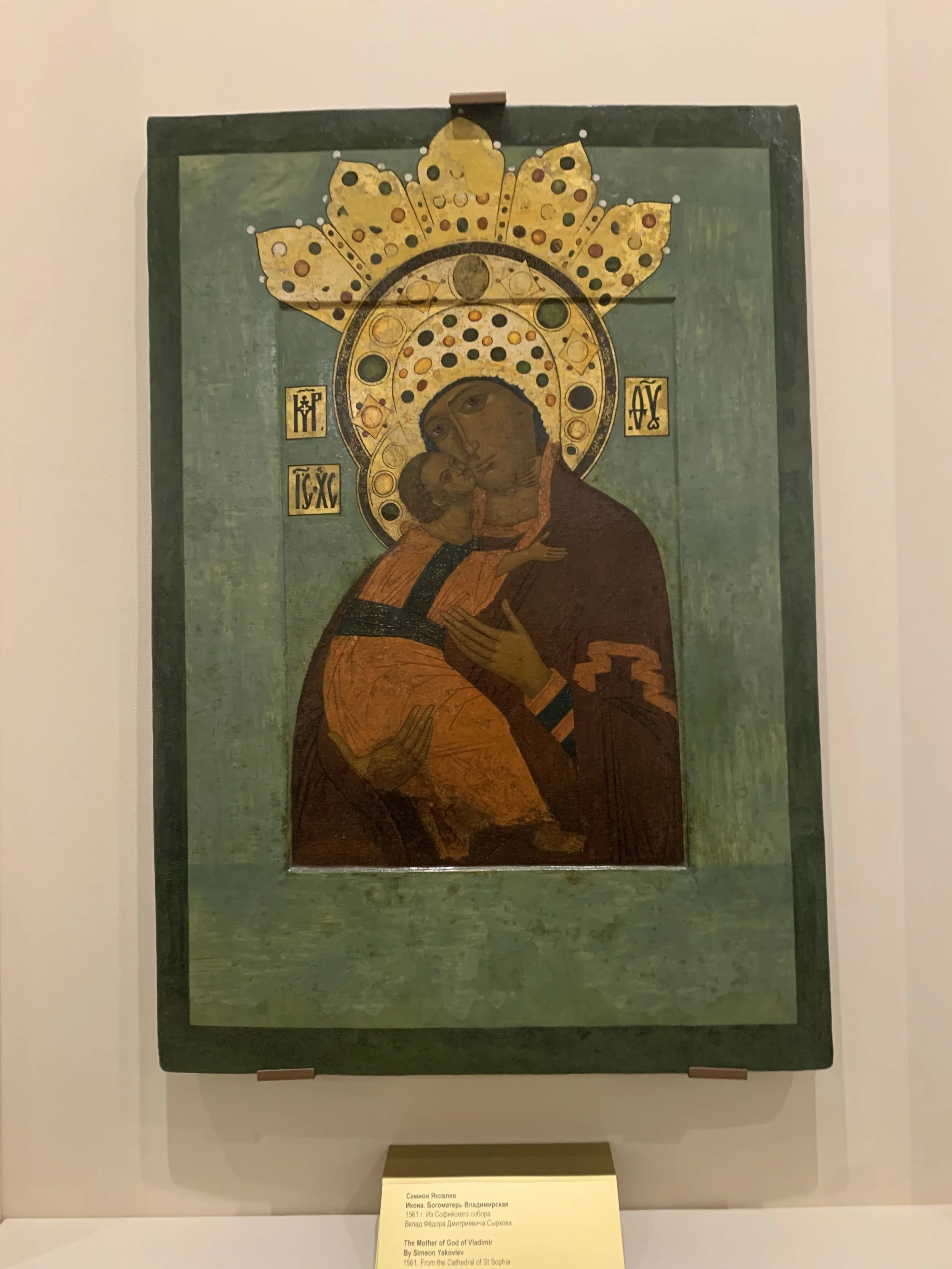
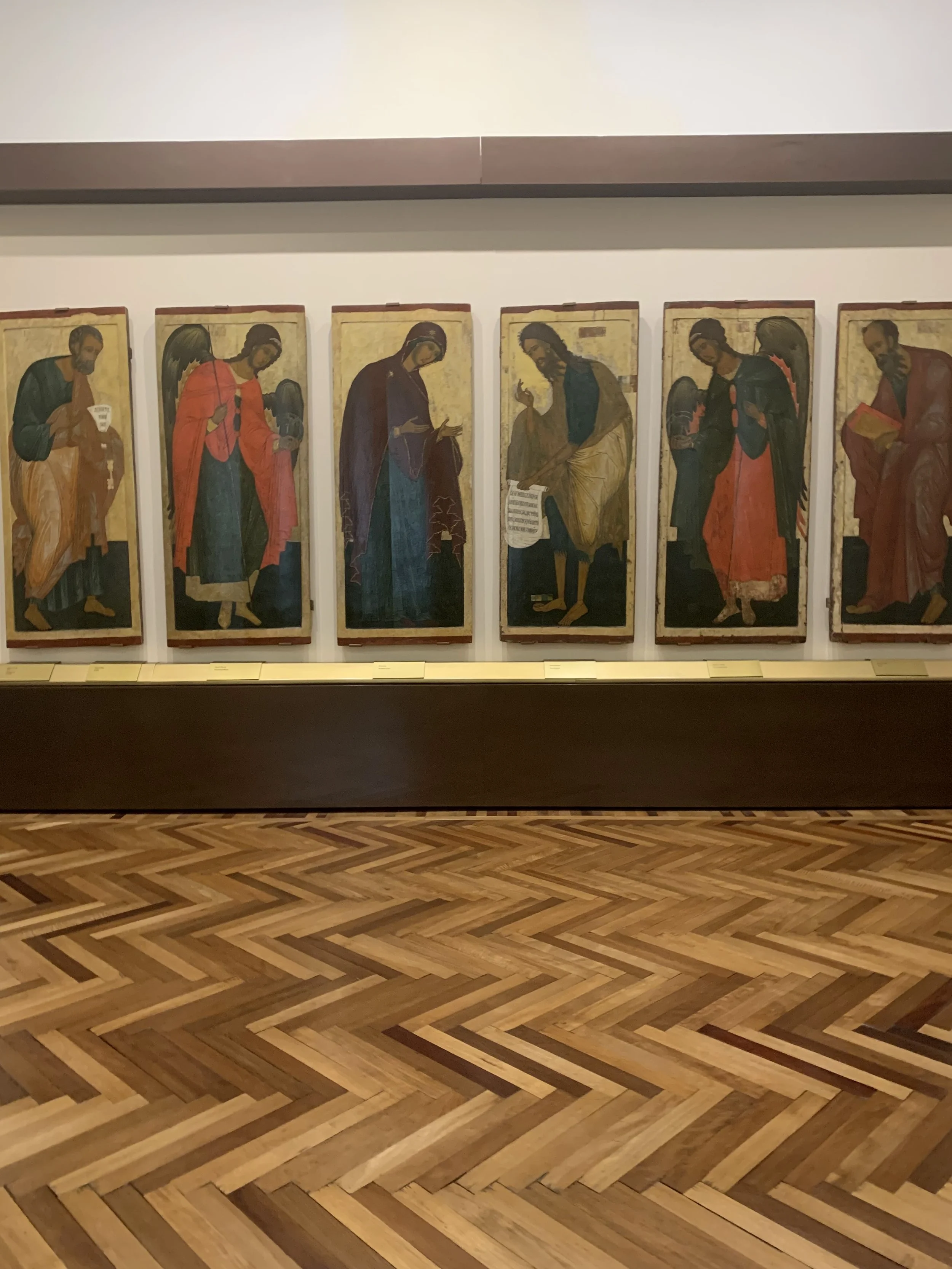
Begin on the second floor of the main museum building, within the permanent exhibition “Russian Icons of the 11th–19th Centuries”. The collection is arranged chronologically, so it’s easy to track the exact stylistic pivot from rigid Byzantine canons to the expressive folk-realism of the local Novgorod School.
Let’s go trhough some of them so you can see what Museum has to offer.
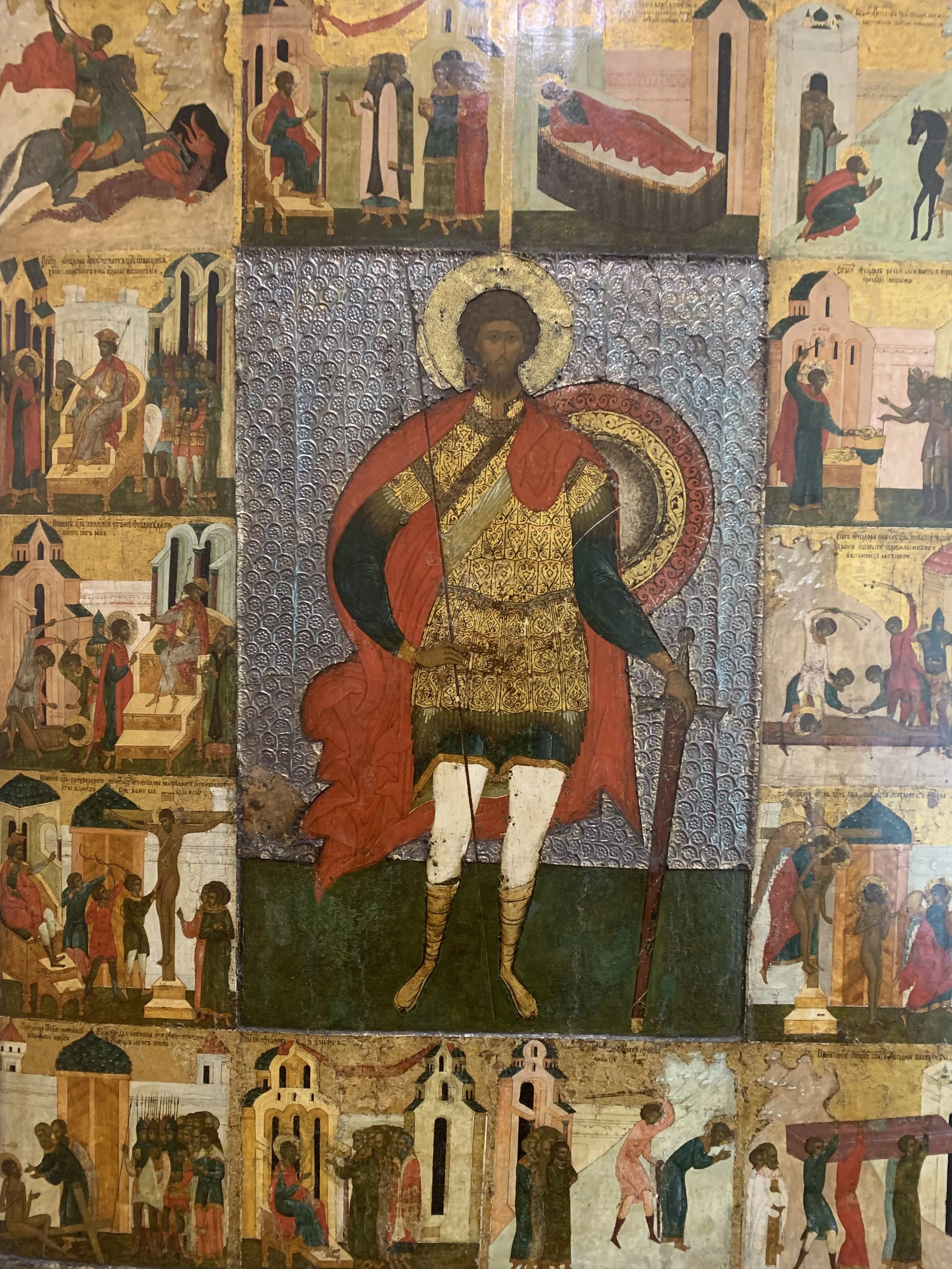
“Saint Theodore Stratelates, with his Life” (late 15th century)
“Saint Theodore Stratelates, with his Life”, late 15th century
This image is a great showcase of how Novgorod masters combined austere Byzantine iconography with a local narrative and love for detail.
Saint Theodore Stratelates, the Great Martyr (a 4th-century Roman military commander), appears before the viewer as an idealized defender of the Christian faith. In his hands, the warrior holds a spear and a lowered sword. The central figure is surrounded by a band of miniature scenes. These 14 stamps sequentially recount the story of the saint’s life, military exploits, and tragic martyrdom.
When viewing the icon in person, pay attention to the textured silver background framing the halo and the figure of the saint. This is basma — the thinnest sheets of hammered or stamped metal with embossed ornamentation. Basma not only protected the wooden base but also created a mystical play of light in the dim light of ancient stone churches.
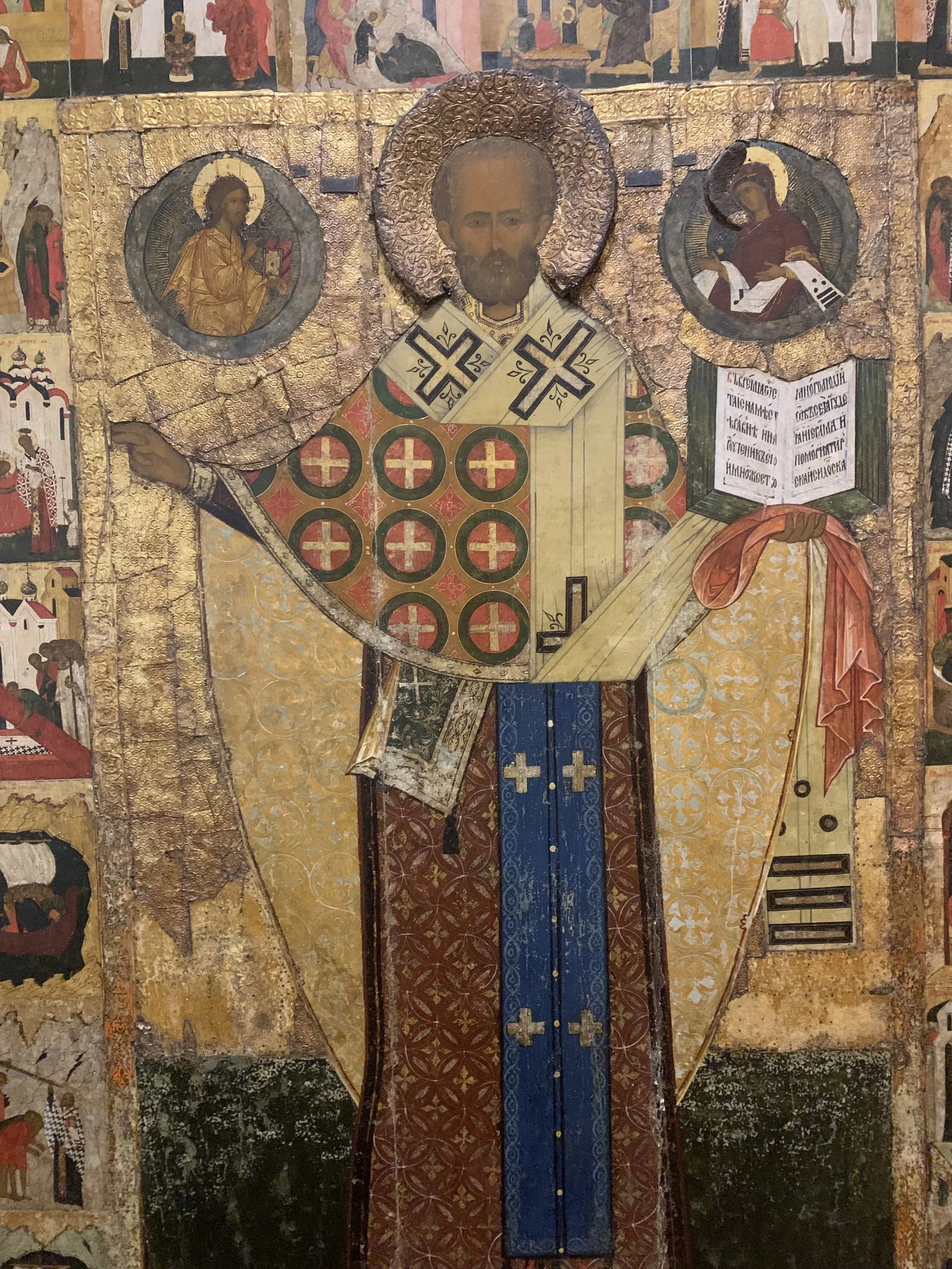
The icon “Saint Nicholas the Wonderworker, with His Life” (from the late 14th to early 15th century).
“Saint Nicholas the Wonderworker, with His Life”, dates from the late 14th to early 15th century.
This is the monument of early Russian religious art from the celebrated Novgorod school of icon painting, particularily the hagiographical tradition of zhiynie (biographical) icons. At its center, Saint Nicholas is depicted in his episcopal vestments, raising his hand in blessing. This focal image is framed by a rich border of narrative panels (kleima), which meticulously illustrate his birth, his ordination, and his legendary miracles — such as rescuing sailors from violent storms and defending the wrongfully accused.
This is the great example of preservation of the Novgorodian artistic identity during a period of cultural revival. The icon tells us about the signature style of the region, which is characterised by bold lines, dramatic facial features, and a luminous palette dominated by cinnabar reds, radiant whites, and rich ochre.
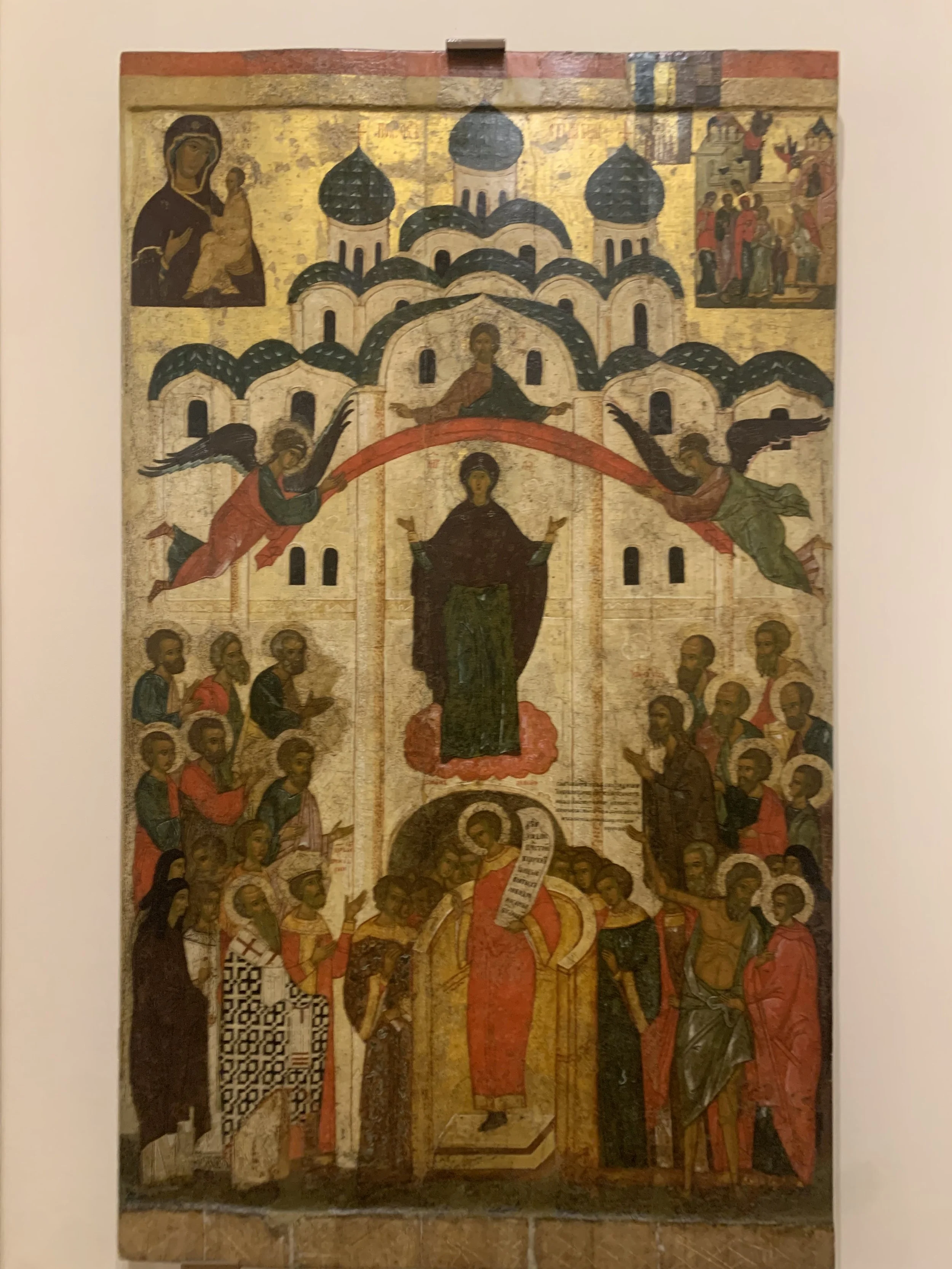
“The Protection of the Most Holy Mother of God”, between late 14th to early 15th centuries
This is one of the examples of the Novgorod school of icon painting from the late 14th to early 15th centuries. The icon’s subject is based on the Byzantine legend of the miraculous apparition of the Mother of God at the Church of Blachernae in Constantinople, when she spread her omophorion (veil) over the worshippers, protecting the city from a pagan siege. This feast day gained immense popularity in Rus’ and became a symbol of heavenly intercession and hope.
The icon’s composition strictly follows the traditional “Novgorod” (or “middle”) style, which differs fundamentally from its Central Russian counterparts. In the center, against the backdrop of a multi-domed white-stone church, the Mother of God rises in the Oranta posture of prayer, and a veil above her head is supported by soaring angels.
Pay attention to the contrasting color scheme — the combination of the radiant golden background and the deep emerald-green maforia of the Mother of God.
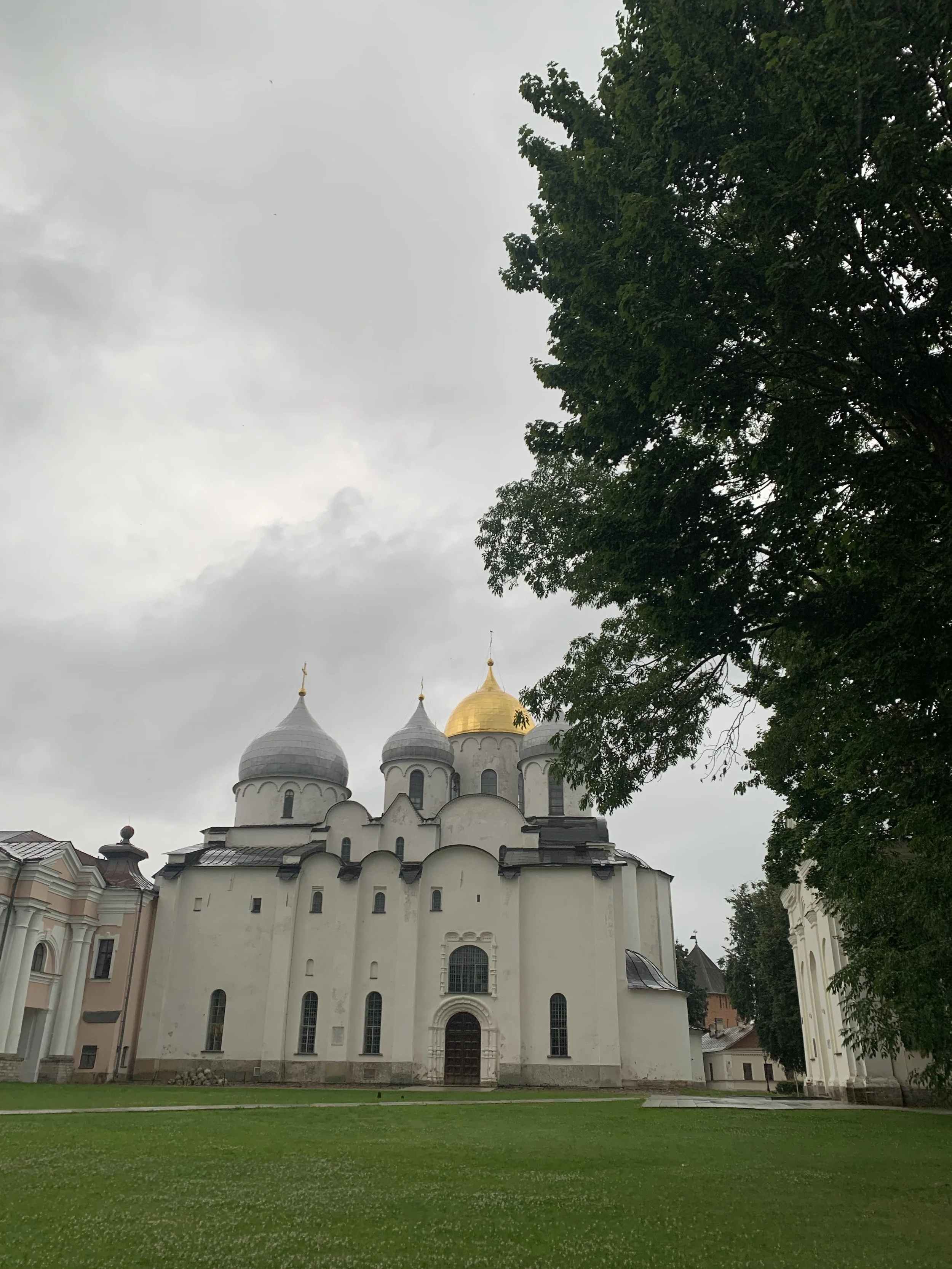
The Cathedral of Saint Sophia, the Holy Wisdom of God, in Veliky Novgorod
Saint Sophia Cathedral (Kremlin, 11)
The legendary Saint Sophia Cathedral, symbol of Veliky Novgorod, is located just steps away from the museum building. Inside, you will see several highly venerated, miracle-working artifacts on the grand iconostasis.
The St. Sophia’s Cathedral, built between 1045 and 1050 is one of the earliest and most significant stone structures of northern Russia. It is officially recognised as the oldest surviving temple built by the Slavs on the territory of Ancient Rus’. The St. Sophia Cathedral is a senior contemporary of iconic European masterpieces like Notre Dame in Paris and the grand cathedrals of Rheims, Amiens, Bamberg, and Naumburg. The five-domed church presents a simpler, more austere silhouette than its thirteen-domed prototype, St. Sophia of Kiev.
Inside the Cathedral you will see dozens of icons of different periods, but I’d like to tell you more about St. Sofia’s murals.
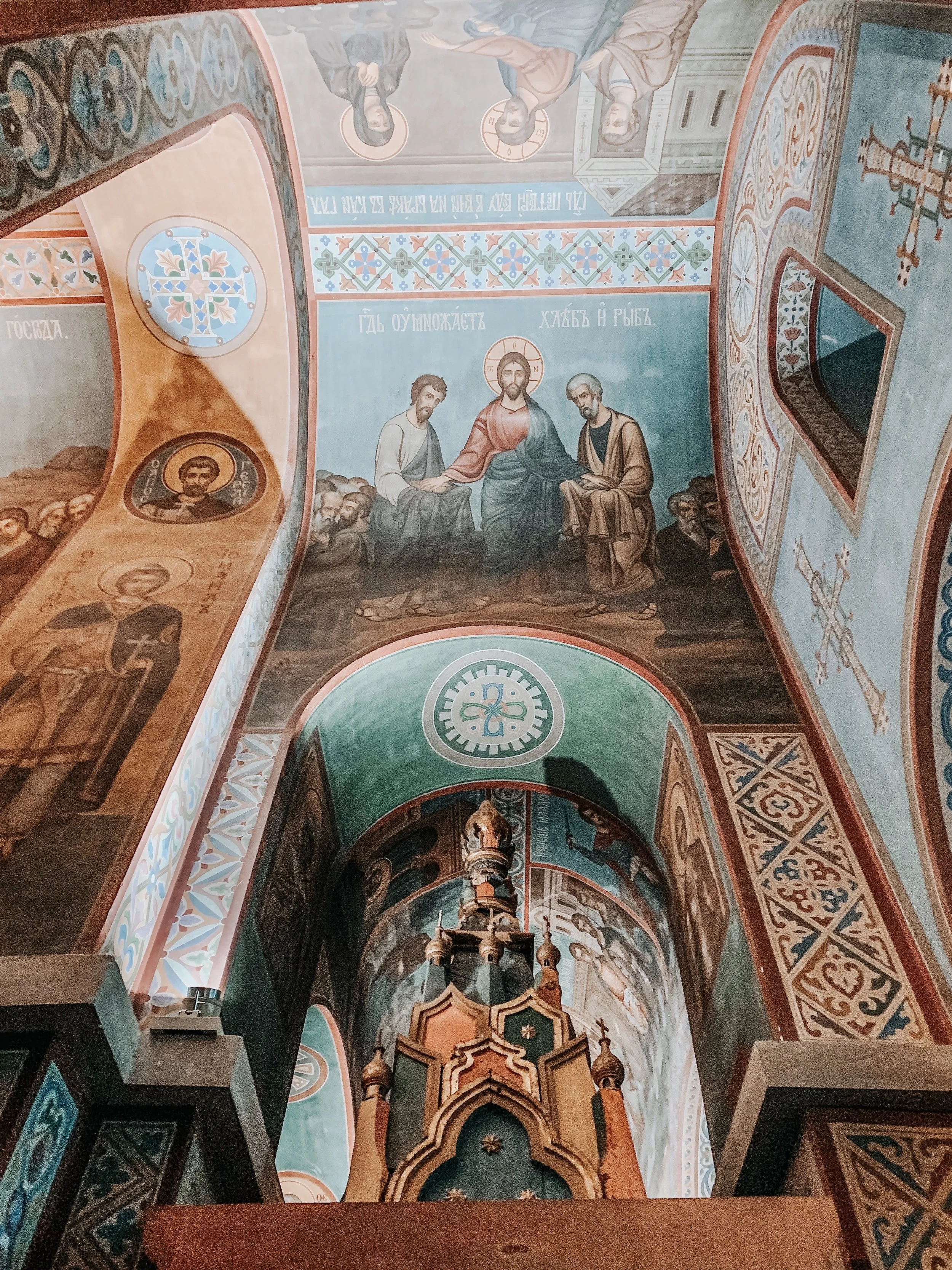
St. Sofia Cathedral interior
Above, is the view of the cathedral’s interior. On the arch’s vault, a fresco bears an inscription in Church Slavonic: “Gd’ oumnazhaya khleb i ryby” (“The Lord multiplies the bread and fish”). This scene illustrates the famous Gospel miracle in which Jesus Christ fed thousands of hungry people who had come to hear His sermon with just a few loaves of bread and fish, symbolizing divine providence, generosity, and the coming sacrament of the Eucharist.
The style of this mural is executed in the finest traditions of Russian academic art of the late 19th and early 20th centuries. Unlike the two-dimensional style of medieval icon painting, the artists here skillfully employ the laws of light and shadow, anatomical accuracy, and a soft, pastel palette dominated by azure-blue and warm ochre tones.
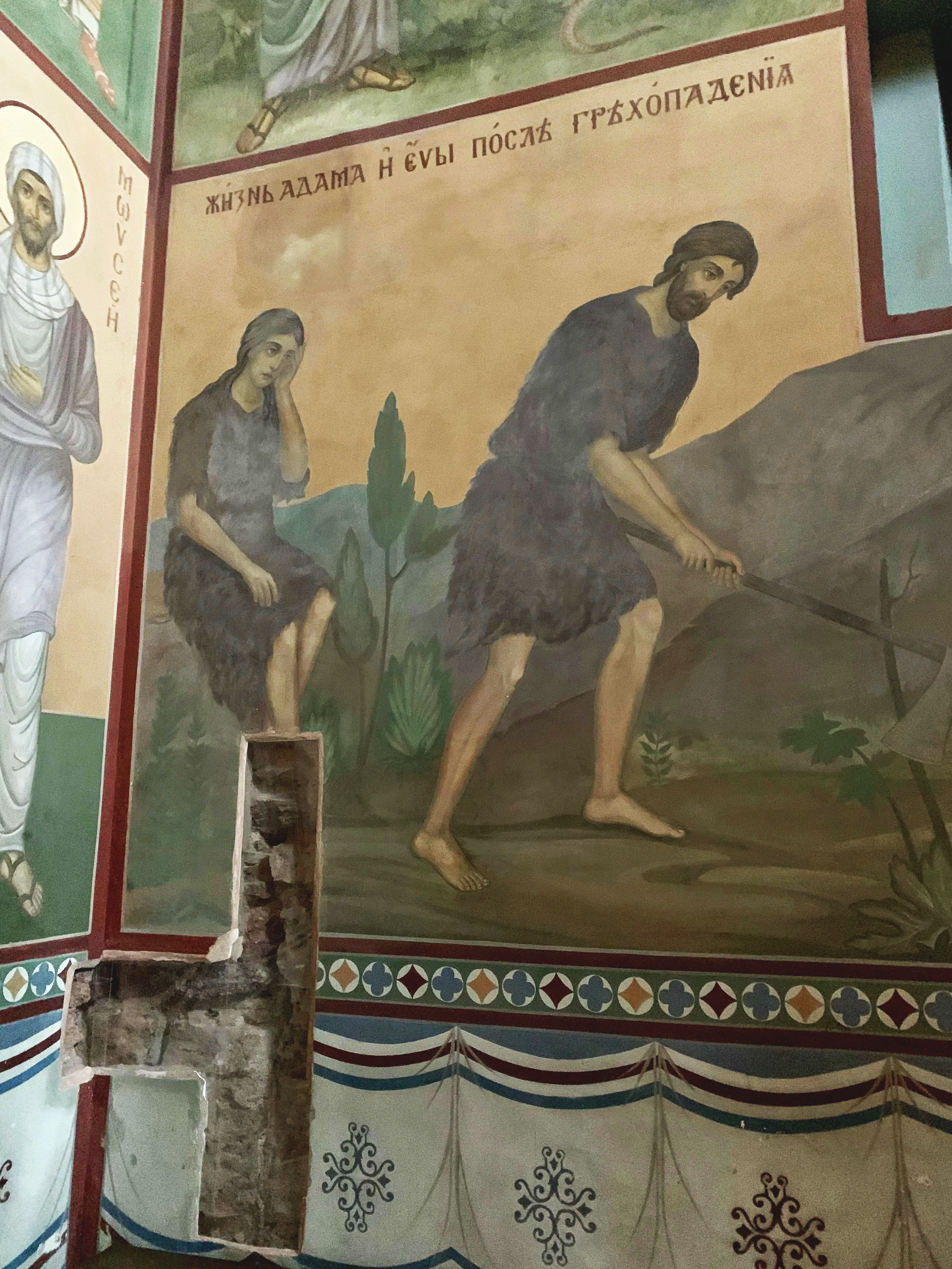
Above, is the fragment of a church mural, or fresco, depicting a biblical scene from the Old Testament. The inscription in Church Slavonic at the top reads: “The life of Adam and Eve after the fall”.
The fresco depicts in detail the consequences of the first humans’ expulsion from Paradise — Adam at work and mourning Eve.
On the left edge, a fragment of an adjacent mural is visible, depicting a saint (the prophet Moses, judging by the vertical inscription “ΜωѴСЕЙ”). At the very bottom, the fresco is bordered by decorative ornamentation and traditional church murals imitating suspended fabrics (towels).
The style of the painting is characteristic of Russian academic or pre-revolutionary church painting (late 19th–early 20th centuries), which was often inspired by the works of masters such as Viktor Vasnetsov and Mikhail Nesterov. Here, the classical canons of Orthodox iconography blend with elements of realism: the three-dimensional rendering of human figures, soft chiaroscuro, natural anatomical proportions, and a detailed landscape background.
General info
St. Sophia Cathedral
Open daily from 8:00 AM to 8:00 PM. Please note that daily religious services take place at 10:00 AM and 6:00 PM (except Mondays and Tuesdays), which may temporarily restrict casual sightseeing inside the main nave. Entry into the cathedral to view the 11th-century frescoes and the miraculous icon is free (donations welcome).
Kremlin Museum
The Main Building of the Novgorod Museum-Reserve (housing the world-renowned pre-Mongol icon collection) is typically open Wednesday through Monday from 10:00 AM to 6:00 PM (closed on Tuesdays and the last Thursday of each month for maintenance). Tickets for adults cost 200 rubles, with discounted rates of 120 rubles available for students and seniors.
Both monuments are situated directly inside the Veliky Novgorod Kremlin grounds (the Detinets). Tickets for the main museum exhibitions can be purchased at the central box offices located nearby within the park grounds or booked directly via the official Novgorod Museum Portal.
