

What does Apeshit video by The Carters (Beyoncé and Jay-Z) REALLY mean for the art world
Almost a decade ago, The Carters, the duo consisting of Beyoncé and Jay-Z, released a music video for the song “Apeshit”. It was in June 2018. The video instantly sent ripples through the relatively calm waters of the pop and art communities.
Filmed at the Louvre, the video not only once again showcased this kitsch couple’s unique style but also made a statement: Beyoncé and Jay-Z — whether rightfully or not — confidently take their place among all these masterpieces in the world’s most prestigious art institution. At first and most superficial glance, it’s just a pop extravaganza in colourful costumes and a dance party set against a backdrop of artistic masterpieces. But what does this video really mean for contemporary culture and for all of us? Let’s try to figure it out.
Table of Contents
Louvre as a premier film set
According to a post on the Louvre’s official X (formerly Twitter) account, the museum hosts approximately 500 different film shoots each year. In 2015, the museum charged a fee of €15,000 per shoot. The celebrity couple submitted their request for the shoot just a few weeks before the planned filming, even though they had been mulling over the idea for a very long time. In an interview with Artnet News, a museum representative said that the couple had visited the museum four times over the past 10 years. According to the staff member, during their last visit in May 2018, the musicians presented their idea to the museum’s management, and although the museum’s filming schedule was tight and the deadline was very close, the couple quickly secured approval of the synopsis and obtained permission to film.
In 2014, the Carters held a photo shoot at the Louvre with the renowned Ethiopian-born artist Avol Erizku. As some of you may recall, Erizku is the photographer who became world-famous for his sensational photos of a pregnant Beyoncé.
So in October 2014, at the Louvre, he took a series of photos capturing the couple with their eldest son, Blue Ivy, against the backdrop of numerous paintings and sculptures that we now see in the “Apeshit” music video. First and foremost, of course, is da Vinci’s “Mona Lisa”, the most famous painting in the world.
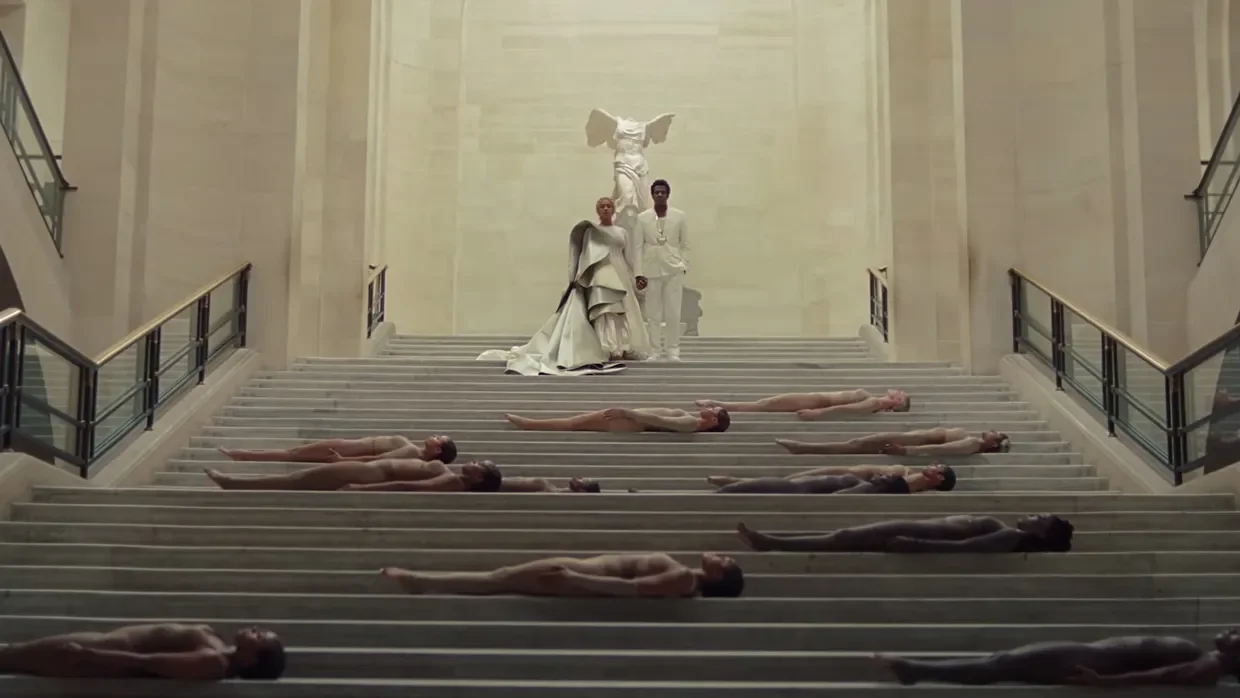
Beyoncé & Jay-Z, "APES**T, The Carters". Screenshot via YouTube
Why The Carter’s video was such an impact
“At this point, Beyoncé and Jay-Z have probably spent more time with the Mona Lisa than the French president has”, — joked Carolina Miranda, the “Culture” columnist for the Los Angeles Times, on her Twitter account. Some commentators point to the symbolic significance of the video.
An art history student who goes by the handle @tsmeheidi_h (the original post is not available, or deleted by June 2026), tweeted that the singer “visually asserts herself as the Mona Lisa” and that “in essence, #Apeshit is not only striking proof of Beyoncé and Jay-Z’s success, but also an acknowledgment of their success in a historical/contemporary context, as well as an expression of gratitude to their predecessors, who are often forgotten”.
In a 2017 interview with The New York Time, Beyoncé said:
“I think it was very important to my mom to surround us with positive, powerful, and strong images from African and African American art so that we could see ourselves in them”.
Now, the singer is not only recreating these images for herself; she is also reinterpreting European classical art within the context of African American culture.
This theme is perhaps most fully explored in the shot where Beyoncé and a troupe of dancers look at the camera against the backdrop of Jacques-Louis David’s painting The Coronation of Napoleon and Empress Josephine. This is a reference to a 2014 photograph showing the Carter family intently observing European royalty. And, of course, one cannot overlook some of the music video’s most beautiful shots, in which Beyoncé poses alongside her husband while wearing traditional African attire.
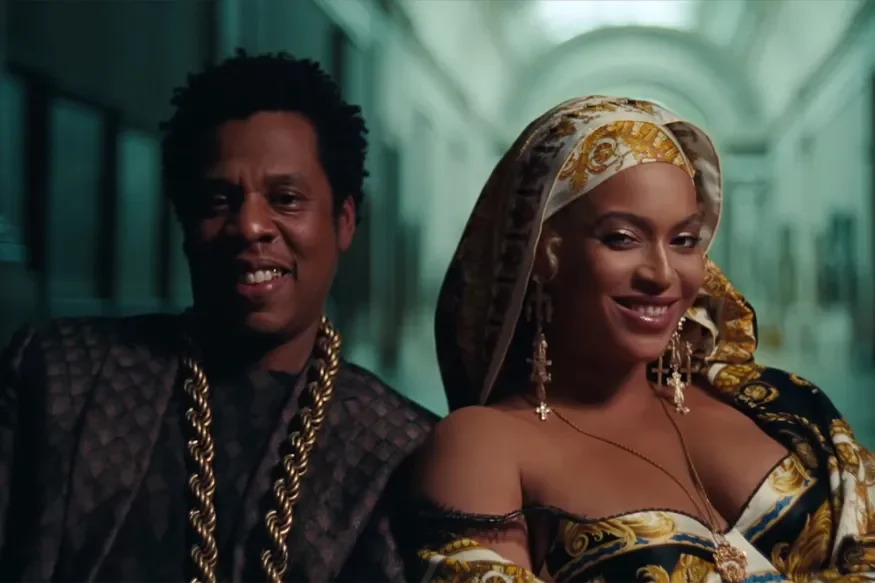
Beyoncé & Jay-Z, "APES**T, The Carters", Courtesy Photo
By the way, in 2014, the couple also posed in front of one of the Louvre’s most famous sculptures, at the foot of the staircase leading to the Winged Victory of Samothrace. Then, this staircase also features prominently in the “Apeshit” music video.
In other shots, we see various exhibits and landmarks of the Louvre, including the chandeliers of the Grand Gallery, the statue of the Great Sphinx of Tanis, and I.M. Pei’s glass pyramid at the museum’s entrance, as well as masterpieces such as the Venus de Milo, Théodore Géricault’s painting The Raft of the Medusa, by Théodore Géricault, “Portrait of Madame Recamier”, “The Oath of the Horatii” and “The Rape of the Sabine Women” by David. Beyoncé and Jay-Z position themselves within the Western artistic canon, thereby advocating for the importance, equal participation, and presence of people of color in the majestic halls of the temples and museums of European civilization.
Decoding “Apeshit”. Key visual markers and their meanings
The Mona Lisa vs. Pop queen
The painting: Portrait of Lisa Gherardini, wife of Francesco del Giocondo (Leonardo da Vinci, c. 1503–1519).
The punch: the Salle des États is the most heavily fortified room in the Louvre, and the Mona Lisa Is the world’s famous painting, the symbol of Western classic art.
The opening shot places the couple directly in front of the masterpiece. They are dressed in matching pastel-toned outfits; the silk fabric contrasts with the dark, glazed tones characteristic of High Renaissance painting. Here, Beyoncé effectively places herself on the same level as Leonardo da Vinci’s masterpiece. She stands perfectly still, mirroring the Mona Lisa’s enigmatic, fixed gaze. The traditional role of Black figures in classical art is reimagined: whereas Black people were historically depicted merely as nameless servants, slaves, or exotic background figures, a Black woman now stands as the central focus of attention and significance.
The Carters deliberately positioned the film set in front of the Mona Lisa to boldly and directly embed the story of Black success into the very heart of Western art. This message runs as a common thread throughout the entire music video.
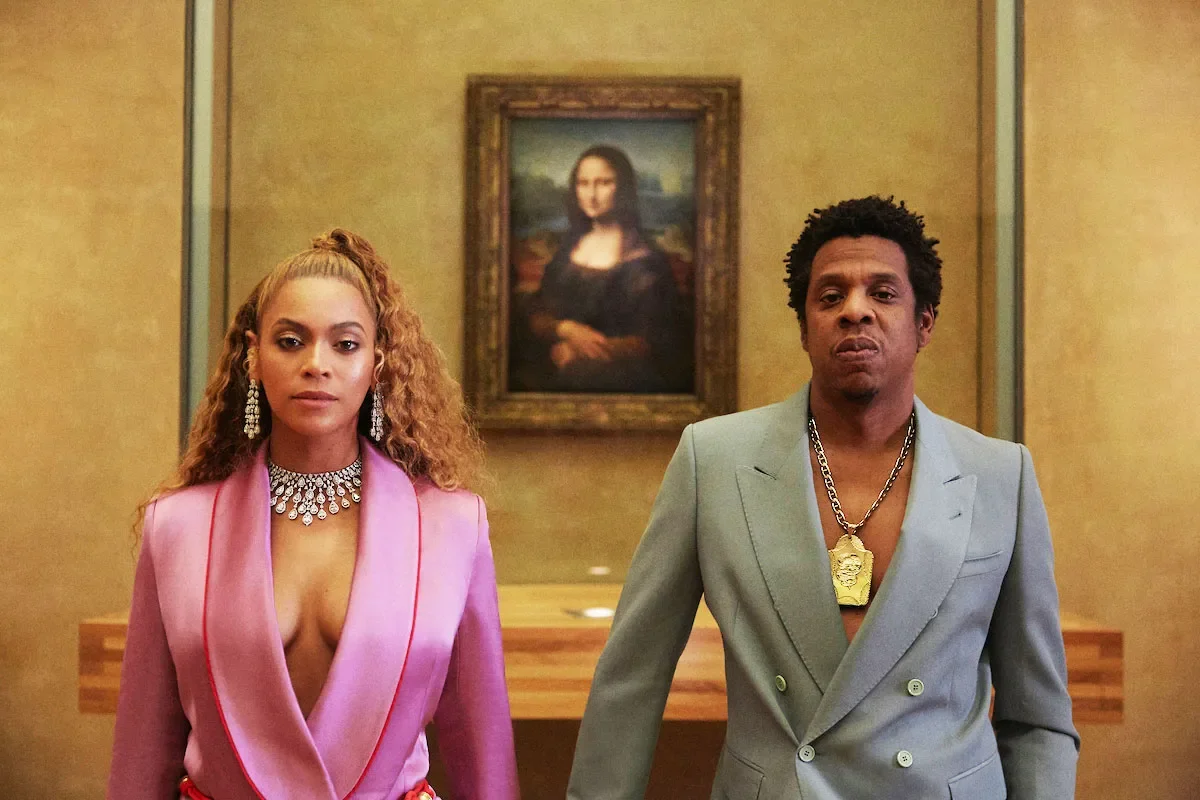
Beyoncé & Jay-Z, "APES**T, The Carters", Courtesy Photo
The coronation of Napoleon. Power, subversion, and the new Monarchy
The Painting:The Coronation of Napoleon and Empress Josephine in Notre-Dame de Paris on December 2, 1804 (Jacques-Louis David, 1805–1807).
The punch: room 75 of the Denon Wing is a massive gallery dedicated to large-scale 19th-century French masterpieces. The whole room is an epitome to power and imperialism.
In perhaps one of the music video’s most striking shots, Beyoncé and eight Black female dancers line up directly in front of a monumental canvas by Jacques-Louis David—a work nearly ten meters wide. Holding hands, the dancers form a continuous, undulating human chain that echoes the architectural rhythm of the French court depicted in the painting.
This entire composition is nothing but as a direct metaphor for institutional equality and the issue of historical erasure. David’s painting is a prime example of political propaganda, capturing the moment Napoleon Bonaparte broke with papal tradition to crown both himself and his wife, thereby disregarding the authority of Pope Pius VII.
This tableau is a reference to their personal photograph taken in 2014, showing the Carter family viewing this painting.
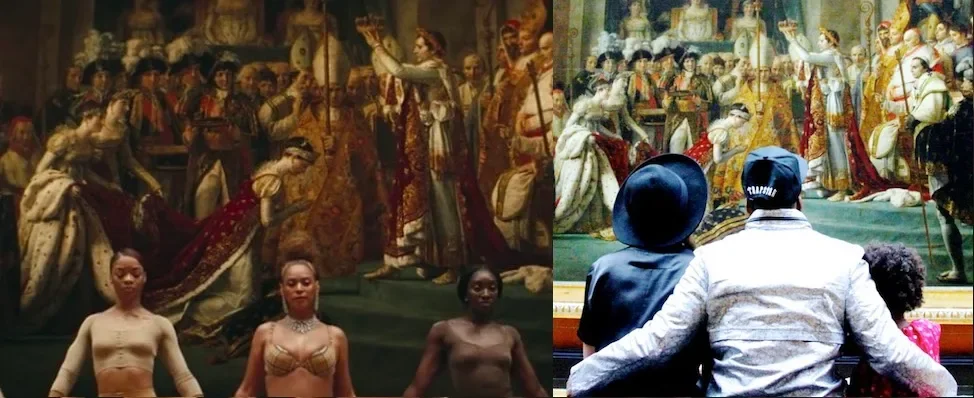
Beyoncé & Jay-Z, "APES**T, The Carters", and the Carter’s photo from personal archive, Courtesy Photo
Portrait of Madame Récamier vs. Portrait of a Negress
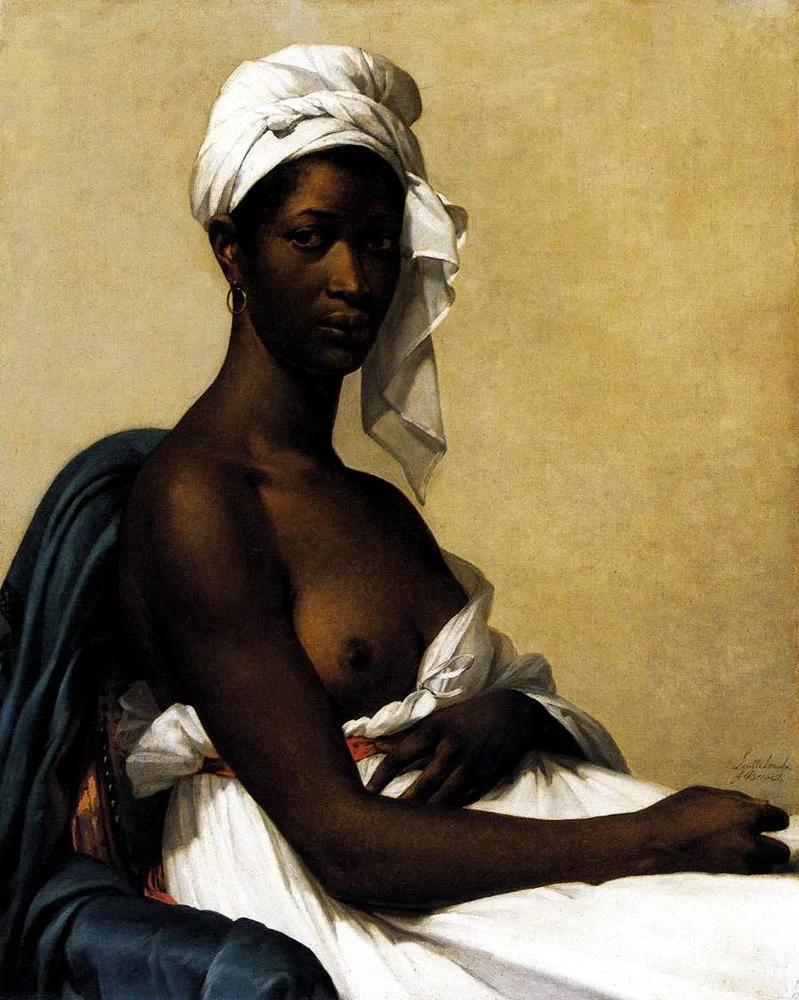
The paintings: Portrait of Madame Récamier (Jacques-Louis David, 1800) and Portrait of a Black Woman (Marie-Guillemine Benoist, 1800, originally exhibited as Portrait d'une négresse).
The punch: both paintings were created in the exact same year, 1800, during the height of French Neoclassicism.
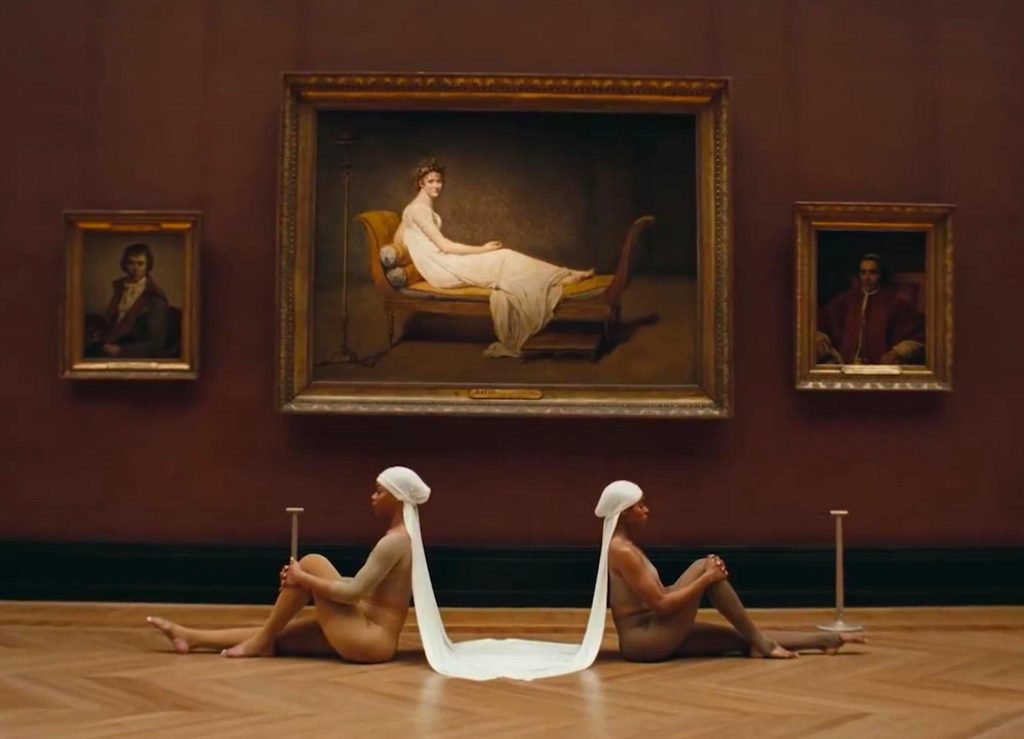
Jacques-Louis David’s famous painting Madame Récamier depicts the wealthy and elegant French socialite Juliette Récamier reclining on a chaise longue. She sought to embody the ideal of refined aristocratic femininity.
Fun fact: Juliette did not like the painting and ultimately refused to purchase it from the artist.
In the music video, Beyoncé recreates this pose, yet the scene’s context is completely transformed by a heavy trap beat.
The most powerful moment of the entire video is when the camera shifts completely from the celebrity couple to Portrait of a Black Woman by Marie-Guillemine Benoist. Painted six years after the abolition of slavery in the French colonies, the canvas was revolutionary for its time: it depicts a Black woman not as property or the subject of an exotic caricature, but as an individual possessing dignity and inner strength.
The Venus de Milo. The Carters against the Western Standard of beauty
The sculpture: Aphrodite of Milos (Parian marble, c. 100 BC).
The punch: Part of the Department of Greek, Etruscan, and Roman Antiquities, displayed at the end of a long, dramatic vista in the Sully Wing.
For centuries, the Venus de Milo has been heralded by art academies as the supreme, unassailable standard of female anatomical perfection, proportion, and grace. Her missing arms have only added to her mystique, turning her into an abstract ideal.
The iconography of the shot is, of course, once again built on contrast. Beyoncé stands right next to the statue of Venus, clad in a form-fitting, nude-colored bodysuit that accentuates the contours of her figure. This is a deliberate, provocative juxtaposition. The real, living, beautiful Black body alongside the cold, damaged marble—which embodies a Eurocentric ideal — is the scene’s central meaning.
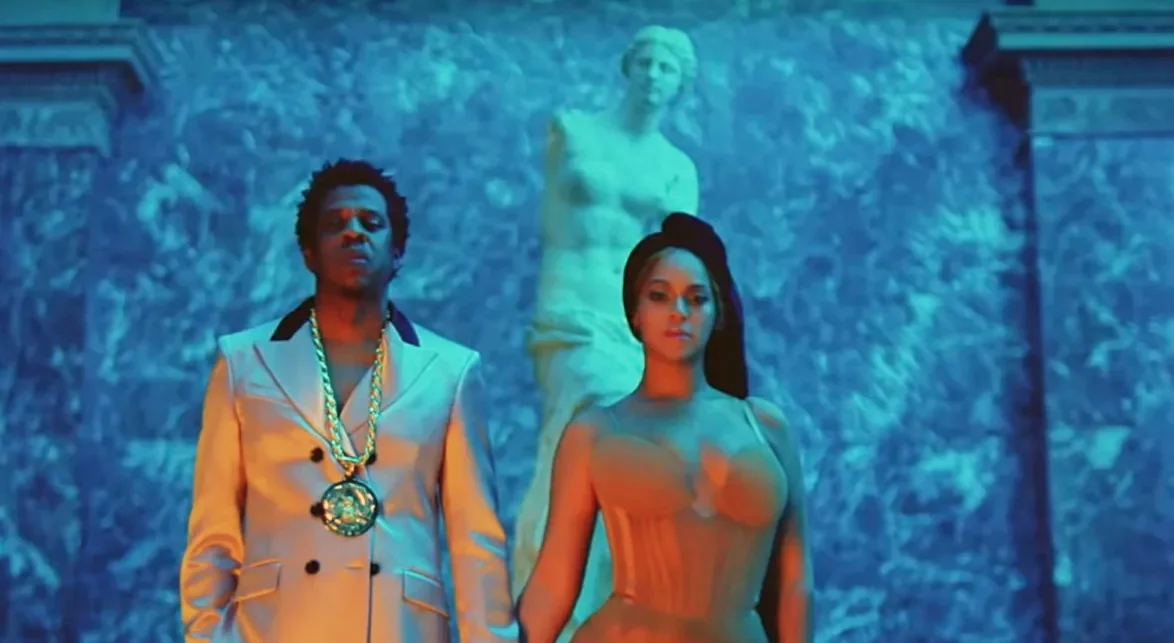
Aphrodite of Milos, Beyoncé & Jay-Z, "APES**T, The Carters". Screenshot via YouTube
The Raft of the Medusa — the politics of state abandonment
The Painting: Le Radeau de la Méduse (Théodore Géricault, 1818–1819).
The punch: A massive, dark monument of French Romanticism is seen as a symbol of European oppression.
Géricault’s masterpiece depicts the gruesome aftermath of the 1816 wreck of the French naval frigate Méduse, where 150 sailors were left to die on a makeshift raft due to the incompetence and cowardice of an aristocratically appointed captain. Crucially, at the absolute apex of the painting’s human pyramid, signaling a passing ship, is a Black sailor named Jean Charles.
The Carters’ inclusion of this specific painting is another masterclass in political allegory. Jay-Z stands alone in front of this massive canvas, lip-syncing lines about systemic oppression, institutional wealth, and survival. The Raft of the Medusa was originally painted as a scathing critique of the corrupt French monarchy and state abandonment.
By including this work into the video, The Carters connect historical European corruption to contemporary issues of systemic racism, socioeconomic disparity, and the state-sanctioned abandonment of marginalized communities (such as the aftermath of Hurricane Katrina, a recurring motif in Beyoncé’s broader videography). The presence of Jean Charles in the painting serves as a historical anchor, proving that Black bodies have always been at the center of survival and historical turning points, even when hidden within European galleries.
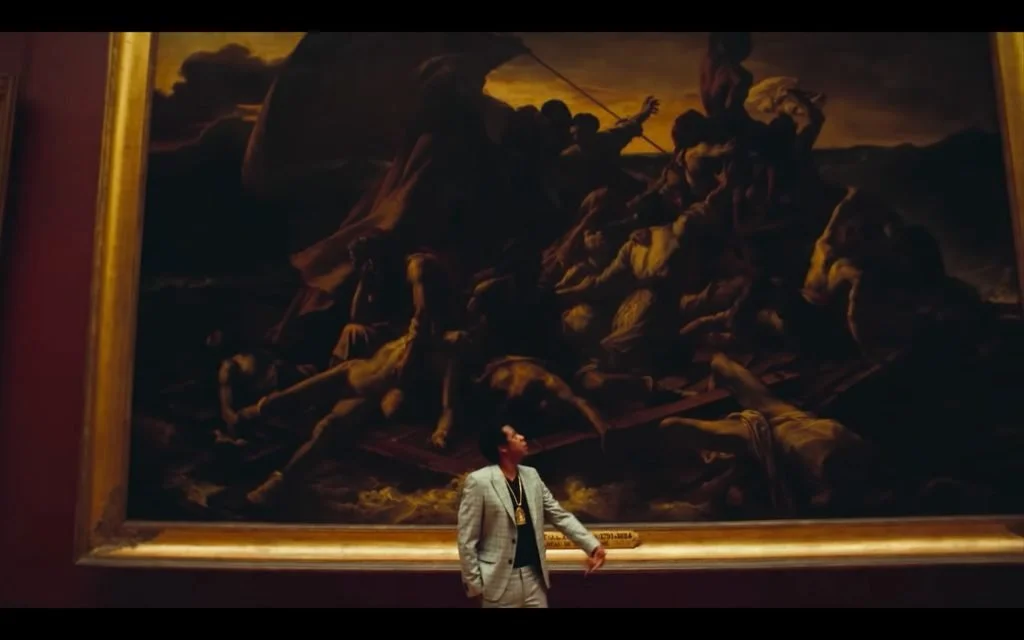
Le Radeau de la Méduse, Beyoncé & Jay-Z, "APES**T, The Carters". Screenshot via YouTube
The list of all works featured in “Apeshit”
Paintings and сeilings
“Apollo Vanquishing the Python” by Eugène Delacroix, 1851 (The spectacular central ceiling panel of the Galerie d’Apollon).
“Madonna with the Green Cushion” by Andrea Solario, c. 1507.
“Jupiter Punishing the Vices” by Paolo Veronese, c. 1553.
“Mona Lisa” / “La Gioconda” by Leonardo da Vinci, c. 1503–1519.
“The Oath of the Horatii” by Jacques-Louis David, 1784.
“The Coronation of Napoleon and Empress Josephine” by Jacques-Louis David, 1805–1807.
“The Intervention of the Sabine Women” by Jacques-Louis David, 1799.
“The Charging Chasseur” by Théodore Géricault, 1812.
“The Raft of the Medusa” by Théodore Géricault, 1818–1819.
“The Ghosts of Paolo and Francesca Appear to Dante and Virgil” by Ary Scheffer, 1835.
“Portrait of Madame Récamier” by Jacques-Louis David, 1800.
“Portrait of a Black Woman” (formerly Portrait d'une négresse) by Marie-Guillemine Benoist, 1800.
“The Wedding Feast at Cana” by Paolo Veronese, 1563 (The massive canvas directly opposite the Mona Lisa).
“Pietà” by Rosso Fiorentino, c. 1537–1540.
Sculptures and ancient antiquities
Winged Victory of Samothrace by Ancient Greek Hellenistic sculpture, c. 190 BC (Daru Staircase).
Venus de Milo by Alexandros of Antioch, c. 130–100 BC.
Great Sphinx of Tanis by Ancient Egyptian sculpture, c. 2600 BC (Old Kingdom, Sphinx Crypt).
“Hermes Fastening his Sandal” by Roman marble copy after a Greek bronze original by Lysippos (4th century BC).
The Carter effect. How pop culture saves the classics
This isn’t the first time Jay-Z has used art as a backdrop for his music videos. In 2013, the video for the single “Picasso Baby” was filmed at Pace Gallery in New York; it featured Marina Abramović and several other leading artists from around the world. Now, thanks to the “Apeshit” video, the Louvre — already the most-visited museum in the world — can expand its audience even further, as artist Jeanette Hayes noted on Twitter. Moreover, in July, the Louvre had already launched a guided tour inspired by “Apeshit.” This is not the first time this has happened. The legendary museum had previously created a tour inspired by the music video for the single “Smile Mona Lisa” by American rapper will.i.am, released in 2016. Thus, in the 21st century, pop icons are serving as guides — without exaggeration — for millions of people to classical art.
Setting aside the huge number of memes that appeared online after the video’s release, a more serious consequence of this music video is the continuation of such an important phenomenon as the discourse on race and culture in the modern world, as well as the urgent need for contemporary society to engage with the legacy of the past.
