
What Happens When the Clown Stops Performing?
“A fire broke out backstage in a theatre. The clown came out to warn the public; they thought it was a joke and applauded. He repeated it; the acclaim was even greater. I think that’s just how the world will come to an end: to general applause from wits who believe it’s a joke.” — Søren Kierkegaard, Either/Or, Part I, 1843
There is a horrible silence after the laughter has died. It is in this hollow space that Anastasia Pollard situates her portraits of clowns. The costume remains, but the performance has ceased. In this arrested performance, Pollard captures a person instead of a character.
While the classic circus clown was often marketed as a symbol of joy, the clown figure has always had a latent capacity for darkness and melancholy. This duality has fractured, splitting into contradictory forms: the enforced, commercial optimism of Ronald McDonald and the anarchic, liberated despair of the Joker. Pollard’s choice to paint clowns is, therefore, an immediate thesis. In her 2024 RP Award works Dott Cotton and Sugar, the complex reality behind the stage is rendered in flesh and paint. This story continues in the 2025 portrait, Malaise.
The concept of a ‘sad clown’ isn’t new in Western culture. However, Pollard’s clowns feel different. They bypass theatrical melancholy altogether. She strips away the usual tricks—rejecting the grand gestures and the dramatic chiaroscuro that traditionally telegraphs a “tormented soul.” Instead, she offers a quiet focus on the reality of fatigue. The clown becomes an anti-image, an icon of emotional residue rather than a performance of emotion.
The work of art, here, refuses to resolve. Dott Cotton, Sugar, and Pollard’s other clowns are a contemporary memento mori—not of physical death though, but of the exhaustion of the spirit. It is a reminder of the cost of keeping up appearances and the price of the emotional labour of professional clowns.
The fact that Anastasia Pollard chooses clowns as models in her art is already significant in itself. The fact that they are selected for an exhibition of one of the most prestigious drawing awards is even more so. To be portrayed = to be seen.
You see, the last few years have been marked by grim historical events, from the pandemic to numerous military conflicts. The concept of celebration and joy is undergoing changes for many people. Depending on the specific situation, celebrations either change their form and intensity or do not exist at all as external events, especially when it comes to regions of war or people directly or indirectly affected. Therefore, returning to the inner state of celebration is particularly interesting today from various points of view, including psychological, social, economic, and, of course, artistic.
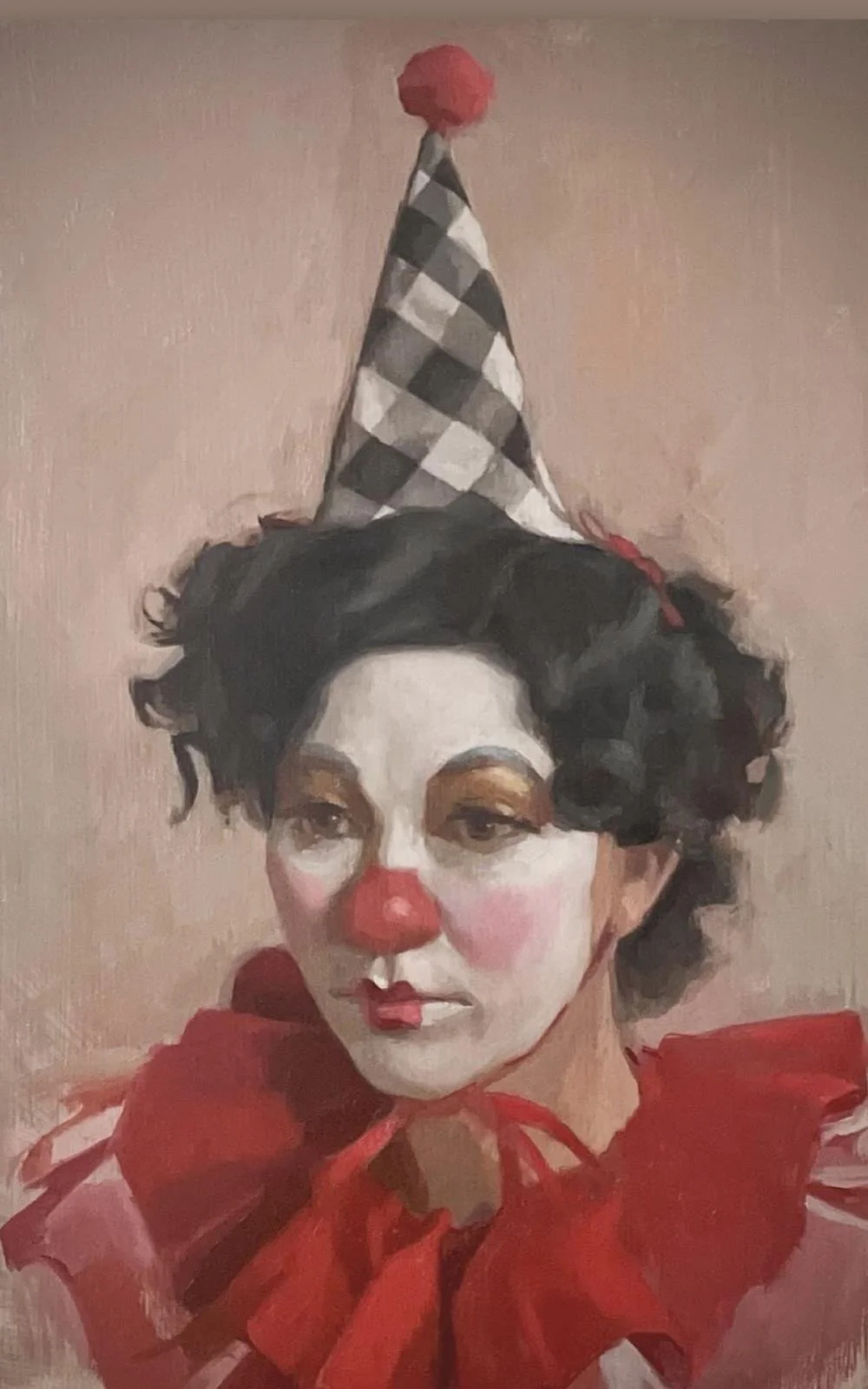
Anastasia Pollard RP, Dott Cotton
Oil on panel, 25x20cm (30x25cm framed)
Dott Cotton is a character that already folds fiction into flesh, a beloved, tragicomic personage from British contemporary culture. The sitter’s red nose and frilled collar might imply celebration, but her eyes tell another story. It is a story of distance, reflection, even withdrawal. Behind the clown’s eyes always lies the echo of a private silence. Dott Cotton in Pollard’s work is not so much an archetype of joy as an emblem of the internal contradictions carried by those whose work is to entertain.
In Sugar, the sitter is also represented in full psychological density. Pollard employs a claustrophobic composition, bringing the figure close to the picture plane. This intimacy forces an interaction, where the portrait from a mere depiction becomes a psychological landscape. Here, the costume is not a disguise but a wound worn in plain sight. What’s remarkable is both Sugar’s and Dott’s authentic looks as clowns that take us back to classic Emmett Kelly performances or the existential theatricality of Pierrot in Watteau’s Gilles. Nothing is extra; everything is slightly understated. Even the muted tones and rough brushwork are so natural and comfortable here that they somewhat resemble Manet’s insistence on flatness and materiality.

Anastasia Pollard RP, Sugar
Oil on panel, 36x28cm (41x33cm framed)
In Malaise, all attention goes to body language. For clowns, the body is nothing but a work tool, roughly speaking, and a vessel they employ to convey emotions to a spectator, poetically speaking. In any case, they normally need to be tense, active, focused, and toned, but here, the sitter is depicted completely differently in all honesty. The clown’s body, despite its physical strength, is soft, inert, and lethargic, sitting next to their beloved one lying in bed, sick. The work’s power lies in this stark dichotomy: symbolically, the clown represents joy yet embodies grief; intuitively, we feel the caregiver's fatigue; aesthetically, the composition finds a brutal honesty in inertia.

Anastasia Pollard RP, Malaise
Oil on panel, 87x56cm (92x61cm framed)
Pollard’s work reveals hidden human tensions rather than evidence. Reminding me of Picasso’s Saltimbanques or Rouault’s tragic clowns, Pollard’s clowns occupy a liminal space between outer artifice and inner honesty.
The clown is not an easy image to decode whatsoever. I am borrowing Mikhail Bakhtin’s theory of the carnivalesque to decode the modern clown, looking at them through the prism of Pollard’s portraiture. But, if Bakhtin saw the clown and fool as carnivalesque truth-tellers (opposing laughter to the world of tragedy) our era demands a new reading. Today, in a state of constant political and social turbulence, the carnivalesque does not oppose tragedy but consumes it; the two are inextricably fused. It is inevitable. Through Pollard’s eyes, the clown’s role evolves into a paradox: a symbol of resilient subversion that also reflects our contemporary condition of being perpetually watched. Like grass growing through asphalt, the clown’s work remains strong and brave, yet it now mirrors the modern demand to perform—to emote, entertain, and affirm — amidst profound sadness, social fragmentation, and internal fracture.
There's a real disconnect between the things we're supposed to celebrate, like birthdays and holidays, and how we actually feel about them. These events demand happiness, even if we’re not feeling it.
A thinker Byung-Chul Han calls this our “performance society.” The pressure doesn’t come from a boss yelling at us anymore; it comes from inside. We feel we have to constantly improve, always be seen, and act happy on command. We have to look like we have it all together, all the time. Pollard’s sad clown portraits push back against this demand. They quietly say no on our behalf too. Han says this non-stop performance leads to a deep tiredness (a total burnout) because we are our own worst slave-driver.
This gets even more intense during times of crisis. You have to wonder: are we still a high-performance society when the world is falling apart?
The weird thing is, the performance doesn’t stop. It just gets weirder and more desperate. The act of trying to seem normal—posting online, celebrating holidays in the middle of a warzone is a way for some people to cope. For others, it feels completely fake and isolating.
The performance society doesn’t vanish in a crisis. It becomes a broken stage where acting strong or optimistic for others crashes right into the real, unbearable pain of trauma and loss. In these moments, we see how brutal and impossible this demand to perform really is.
And so, Pollard’s clowns mirror this condition; their performative garb is offset by stillness and introspection. They are not caught in motion but frozen in thought. Perhaps their greatest power is the permission they grant us. In their silent, seen stillness, they validate our own desire to pause. To stop performing. To simply be. They propose a new celebration, one where truth exists not in smiles and applause, but in the courage of falling silent.
They sit still. They let themselves be seen.
They don’t smile. This moment of their silent inward stillness is moving.
